

Why Business Owners Face Unique Challenges in Divorce
Divorce with business ownership creates complex legal and financial challenges that go far beyond typical asset division. When your marriage ends and you own a business, you’re not just splitting household items and bank accounts—you’re potentially dividing your primary source of income and the company you’ve worked years to build.
Key impacts of divorce on business ownership:
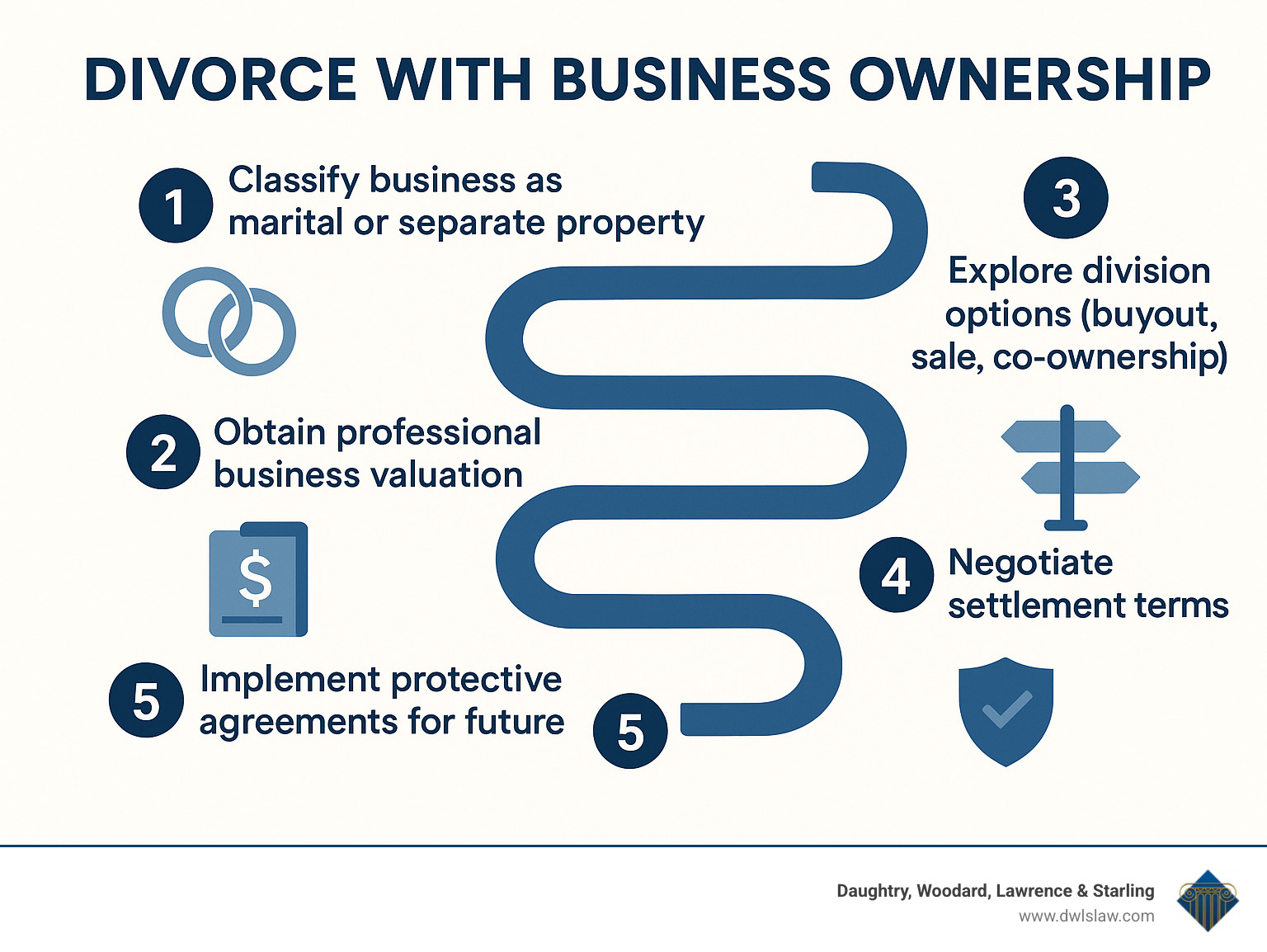
- Asset Classification: Courts determine if your business is marital property, separate property, or a mix of both
- Valuation Requirements: Professional appraisers must establish your company’s worth using asset-based, income-based, or market-based methods
- Division Options: You may face a buyout, forced sale, continued co-ownership, or asset trade arrangements
- Operational Disruption: Divorce proceedings can interrupt business operations and affect employee morale
- State Law Variations: Community property states typically split assets 50/50, while equitable distribution states like North Carolina divide assets fairly but not necessarily equally
Nearly 30% of Americans are self-employed or own a small business, making this a common concern in divorce proceedings. In many cases involving business owners, the company represents the largest marital asset to be divided.
I’m Kelly K. Daughtry, and with over five decades of experience at Daughtry, Woodard, Lawrence & Starling, I’ve helped countless North Carolina business owners steer the complexities of divorce with business ownership. Our firm combines comprehensive legal expertise with personalized attention to protect your business interests during this challenging time.
Quick divorce with business ownership definitions:
– divorce and estate planning
– attorneys in johnston county nc
– family law attorneys in smithfield nc
Navigating Divorce With Business Ownership: Key Legal Frameworks
When you’re facing divorce with business ownership, understanding how courts view and divide business assets becomes absolutely critical. Every divorce involving a business starts with one fundamental question: Is this business marital property, separate property, or something in between?
Marital, Separate, or Hybrid?
Separate property includes businesses you started before marriage, received as inheritance, or kept completely isolated from marital funds. The key word is “completely”—even small amounts of marital money flowing into the business can change everything.
Marital property includes businesses you started after marriage, or any company that benefited from marital investments. This includes using marital funds for equipment, employees, or business expenses.
Hybrid property happens when you started your business before marriage, but during marriage, you reinvested profits, used joint accounts for business expenses, or your spouse helped with operations. North Carolina courts don’t just look at direct contributions—if your spouse managed the household while you built the business, that domestic support counts as an indirect contribution.
The Categories used by North Carolina courts for property division recognize that building a successful business often requires one spouse to handle the home front.
Timing matters enormously. Even if you started your business before marriage, any appreciation in value during the marriage may become marital property.
How Different States Split the Pie
Community property states like California and Texas follow a simpler approach. If your business is marital property, your spouse gets half. There’s less room for negotiation, but you know what to expect.
Equitable distribution states like North Carolina give judges flexibility. “Equitable” means fair, not equal. Virginia’s approach under Virginia Code § 20-107.3 considers factors like contributions to the business, earning capacity, and divorce circumstances.
North Carolina judges consider:
– Each spouse’s contribution to acquiring and growing the business
– Economic circumstances of both spouses after divorce
– Length of the marriage and how it affected business growth
– Age and health of both parties
– Any misconduct that damaged the marital estate
This flexibility often leads to creative solutions like offsetting business assets against other marital property.
Valuing the Company: Getting the Numbers Right
Getting an accurate business valuation during your divorce directly determines how much you might owe your spouse or receive in the settlement. Professional forensic accountants examine your company’s financial records, tangible assets like equipment, and intangible assets like customer relationships and goodwill.
Choosing a Valuation Method
Business Valuation Methods fall into three main categories:
The asset-based approach inventories everything your business owns, then subtracts debts. This works for companies with substantial physical assets but may undervalue service businesses.
The income-based approach focuses on earning power. Valuators analyze projected cash flows and financial forecasts to estimate future earnings, then discount to present value. This works well for established businesses with predictable income.
The market-based approach compares your business to similar companies that sold recently. The challenge is finding enough comparable sales data.
Dealing With Disputes Over Value
Different methods often produce wildly different results. The single appraiser model works when both spouses agree on one professional. The dual expert system lets each spouse hire their own appraiser, often leading to better outcomes.
When disagreements persist, arbitration panels offer a middle ground. If cases reach court, experienced legal representation becomes crucial. Our Business Litigation team knows how to present valuation evidence effectively.
Divorce With Business Ownership: Impact of Debts & Liabilities
Divorce with business ownership becomes complex when businesses carry significant debt or personal assets secure business loans. Business loans reduce company value dollar for dollar. The real complications arise with personal guarantees—you remain liable even after divorce.
| Asset Treatment | Debt Treatment |
|---|---|
| Fair market value of business assets | Outstanding business loans |
| Goodwill and intangible assets | Personal guarantees |
| Equipment and inventory | Secured debt obligations |
| Accounts receivable | Tax liabilities |
Options for Dividing or Retaining the Business
Once your business is valued and classified, you face a crucial decision: how to handle the business moving forward. The choice affects your financial future, employees, customers, and the company you’ve built.

Lump-Sum or Structured Buyout
Most business owners prefer maintaining full control through a buyout.
A lump-sum buyout provides immediate ownership and gives your ex-spouse a clean break. The challenge is coming up with large sums while maintaining cash flow.
A structured buyout spreads payments over years through installment notes, protecting cash flow while compensating your ex-spouse fairly. The downside is maintaining a financial relationship for years.
Structured buyouts work best with clear expectations and good communication. See Determining how property will be divided during divorce for guidance.
Sell and Split Proceeds

Selling provides both spouses with liquid assets for fresh starts. However, market timing might not favor you, finding buyers takes time, and employees face uncertainty.
Co-Ownership After Divorce With Business Ownership
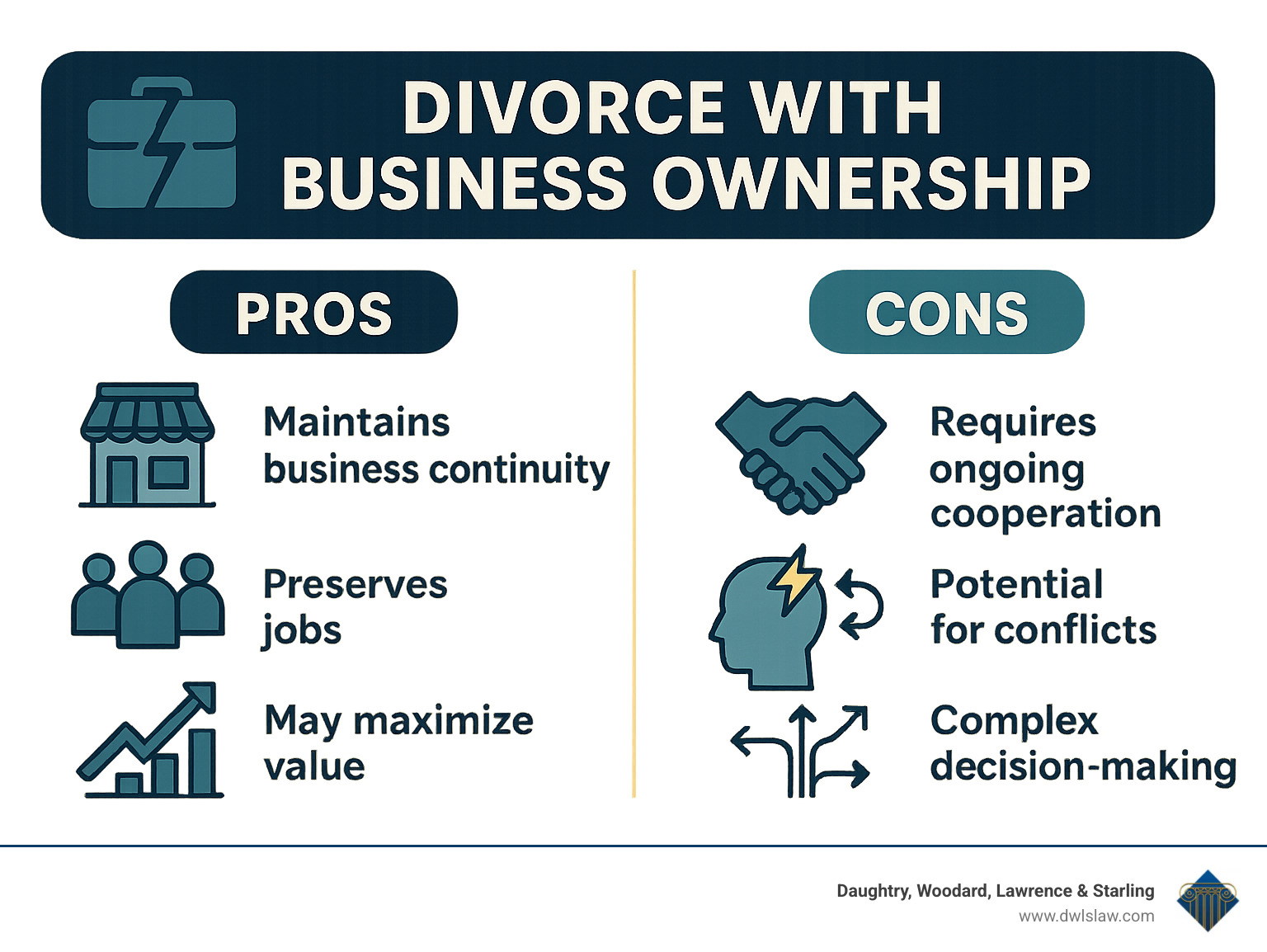
Some divorced couples successfully maintain joint ownership when both are essential to operations. Success requires clear governance agreements and exit clauses. Honestly, co-ownership rarely succeeds long-term due to emotional complexities.
Creative Solutions: Asset Trades & Partitioning
Asset swapping works beautifully—you keep your $400,000 business while your spouse receives the $350,000 home plus $50,000 in retirement accounts.
Business partitioning works for multiple locations. Our team has experience with How do you divide intellectual property in a divorce? cases for knowledge-based businesses.
Protecting the Business Before or During Divorce
Taking protective steps early can save tremendous heartache and financial loss later. Think of it like insurance for your business.
Prenuptial & Postnuptial Agreements
Prenuptial agreements are your strongest defense, clearly designating your business as separate property and establishing valuation procedures.
Postnuptial agreements serve the same purpose after marriage but face tougher court scrutiny. For a postnuptial agreement to hold up, both spouses need independent counsel, complete financial disclosure, and voluntary signing.
Corporate & Shareholder Safeguards
Operating agreements and bylaws can include spouse exclusion provisions and buy-sell clauses. Shareholder agreements restrict share transfers and create forced buyout provisions.
A well-crafted buy-sell agreement prevents your ex-spouse from becoming an unwanted partner while providing predetermined buyout terms.
Day-to-Day Practices That Strengthen Your Position
Keep finances completely separate with distinct business and personal accounts. Document everything with thorough records and financial statements. Pay yourself fairly with consistent, market-rate salaries.
These practices strengthen your business and provide guidance on Protecting finances before the impact of a divorce.
Alternative Dispute Resolution
Mediation offers tremendous advantages: privacy, speed, cost savings, and control over outcomes. Working with a divorce mediation lawyer achieves successful settlements in 98% of cases and allows creative solutions that courts cannot provide.
Frequently Asked Questions about Divorce With Business Ownership
Does my spouse automatically get half of my company?
Not automatically. Your spouse’s claim depends on when you started the business, where you live, and their involvement. Pre-marriage businesses are typically separate property, though growth during marriage might be divisible. North Carolina follows equitable distribution—fair, not necessarily equal—considering who built the business and each spouse’s contributions.
How is child support calculated when my income is tied to business profits?
Courts review multiple years of financial statements to understand your true earning capacity. Business perks get counted as income, and courts might calculate support based on potential earnings rather than actual distributions if your business could reasonably pay you more.
Can both spouses keep working in the company after the divorce?
While possible temporarily, continuing to work together after divorce is rarely successful long-term. When it works, you need crystal-clear agreements about decision-making, profit distribution, and exit strategies. Most divorced couples find it emotionally exhausting to maintain professional relationships with their ex-spouse.
Conclusion & Next Steps
Divorce with business ownership doesn’t have to mean the end of everything you’ve built. With the right approach and experienced guidance, you can protect your business while moving forward with your life.
Getting professional help is essential. Business valuation requires forensic accountants, and legal strategy needs attorneys experienced with similar cases. You have choices: buyouts might preserve control, sales could provide clean closure, or creative asset swaps might protect the business while ensuring fair compensation.
Protecting business operations during this process is crucial. Your employees, customers, and vendors need stability. Most importantly, use this experience to plan for the future through prenuptial agreements, shareholder protections, or better business practices.
At Daughtry, Woodard, Lawrence & Starling, we’ve guided countless business owners throughout Smithfield, Clinton, and Sampson County. We know your business represents more than financial assets—it’s your legacy and your employees’ livelihoods.
Our team combines deep knowledge of North Carolina family law with practical business experience. We have board-certified specialists and bilingual support to ensure clear communication throughout the process.
Contact our experienced Divorce Lawyer team today to discuss your situation. We’ll explain your options and help develop a strategy that protects your business while achieving fair resolution.
Your business survived the challenges of starting up and growing. With the right legal support and strategic planning, it can survive this challenge too.
Frequently Asked Questions
Does my spouse automatically receive half of the business in a divorce with business ownership?
No. In a divorce with business ownership, your spouse’s share depends on state law, when the business was started, how it was funded, and whether your spouse contributed directly or indirectly to its growth.
How do courts value a business in a divorce with business ownership?
Professionals use asset-based, income-based, or market-based valuation methods. In divorce with business ownership cases, accurate valuation is critical because it determines potential buyouts, settlements, and property division.
How do courts classify a business as marital or separate property?
A business is considered separate property if it was started before marriage or inherited, and no marital money or labor was used. If marital funds, reinvested profits, or spousal support contributed in any way, part of the business may be classified as marital.
Can business debts affect what happens during divorce?
Yes. Outstanding loans, personal guarantees, tax liabilities, and secured debts reduce the business’s value. If you personally guaranteed a loan, you may remain responsible even after the divorce unless legally released.
Can both spouses continue working in the business after the divorce?
It’s possible, but generally difficult long-term. Successful post-divorce co-ownership requires well-defined roles, governance rules, profit distribution terms, and clear exit provisions.


