

Planning Your Future Together: The Essentials of Estate Planning for Couples
Estate planning for couples is a comprehensive process that ensures your assets are protected and distributed according to your wishes while minimizing taxes and avoiding probate complications. Here’s what every couple needs to know:
- For married couples: Joint or separate wills, healthcare directives, and powers of attorney
- For unmarried partners: Legal documents to ensure inheritance rights and decision-making authority
- For blended families: Trusts and specific provisions to protect children from previous relationships
- For all couples: Regular reviews and updates after major life events
Estate planning might seem like something only wealthy retirees need to worry about, but the truth is that every couple—regardless of age, wealth, or marital status—needs a solid plan in place. Without proper planning, your assets could be distributed according to state laws rather than your wishes, your partner might be excluded from healthcare decisions, and your children’s guardianship could be determined by a court rather than your expressed preferences.
According to research, more than 40% more unmarried individuals were living with significant others in 2023 compared to two decades earlier, highlighting the growing importance of proper estate planning for all types of couples. Additionally, almost 30% of Americans have stepfamily members, creating unique planning challenges that require careful attention.
The good news is that creating an estate plan together doesn’t have to be complicated or contentious. By approaching the process as a team with clear communication, you can ensure that both partners’ wishes are respected while strengthening your financial partnership.
I’m Kelly K. Daughtry, an attorney at Daughtry, Woodard, Lawrence & Starling with extensive experience helping North Carolina couples steer the complexities of estate planning for couples, ensuring their assets are protected and their wishes are honored regardless of their family structure or financial situation.
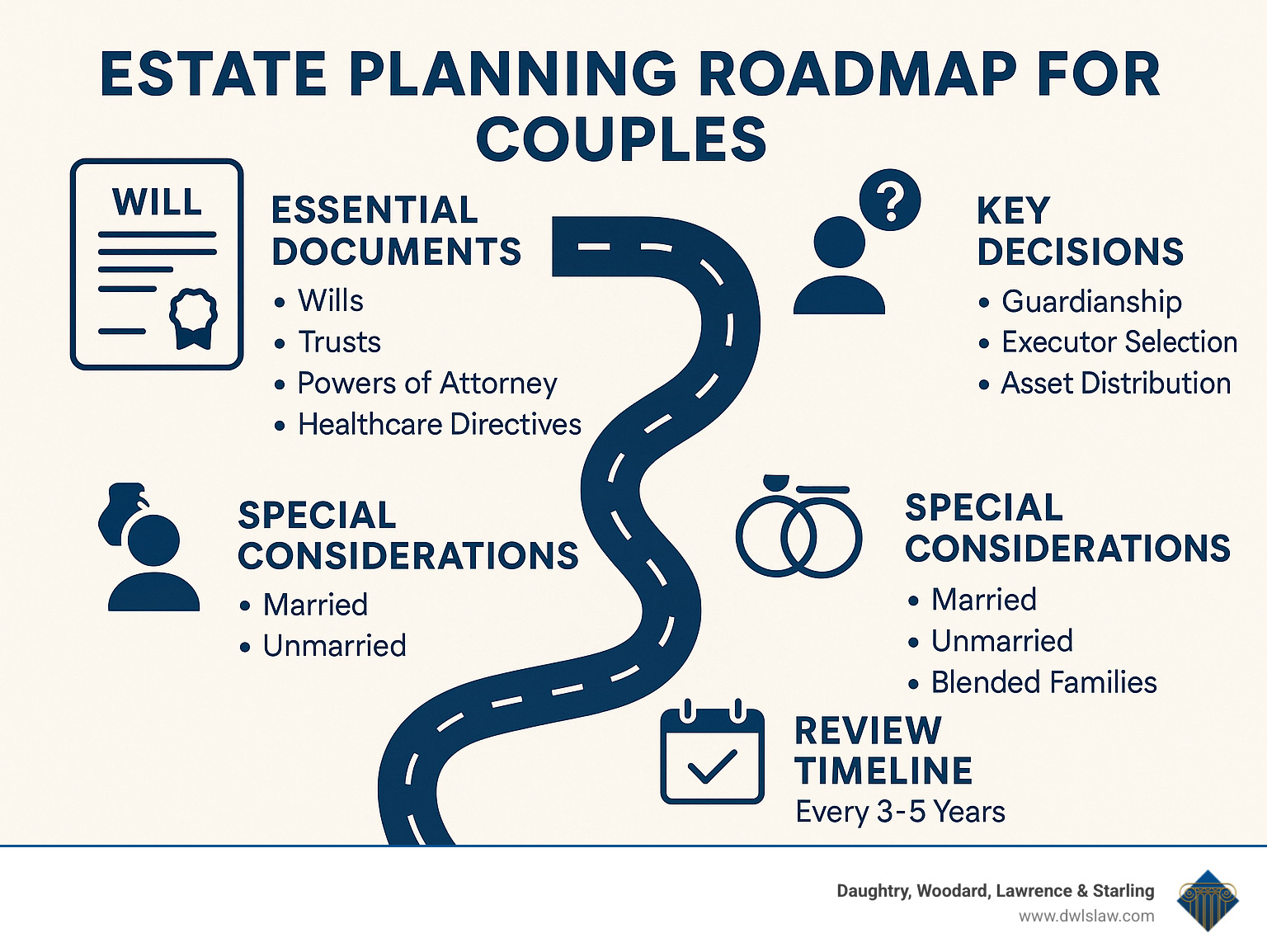
Estate planning for couples terms made easy:
– North Carolina probate attorney
– estate planning for seniors
Why Couples Can’t Afford to Skip Estate Planning
Let’s be honest—estate planning often falls to the bottom of our to-do lists. Between work demands, family responsibilities, and just living life, it’s easy to put off these important decisions for “someday.” But here’s the reality: without proper planning, you’re essentially gambling with your family’s future.
When couples skip estate planning, they face several serious risks that can have lasting consequences:
Intestacy risks can leave your family in a difficult position. If you pass away without a will in North Carolina, state intestacy laws—not your personal wishes—determine who gets what. Many couples assume everything automatically goes to the surviving spouse, but that’s often not the case. If you have children, your spouse might receive only a portion of your estate, potentially creating financial hardship during an already devastating time.
Guardianship gaps create uncertainty for your children. Without naming guardians in your will, a court decides who raises your children if both parents die unexpectedly. This decision may conflict with your values and preferences, and the uncertainty can trigger painful family disputes when your children need stability most.
For the approximately 30% of Americans with blended families, step-family disputes are a real concern. According to research from the National Center for Biotechnology Information, stepchildren typically have no legal right to inherit without specific provisions. Without clear estate planning for couples in blended families, stepchildren you’ve raised and loved can be completely excluded from your legacy.
Incapacity crises don’t just affect the elderly. If you become temporarily or permanently unable to make decisions due to an accident or illness, your spouse may need to petition the court for authority to handle your affairs—a process that’s stressful, expensive, public, and time-consuming.
Probate delays can tie up your assets for months or even years. Without planning to avoid probate, your estate may be stuck in court proceedings, delaying distributions to your loved ones and potentially reducing what they receive through court costs and legal fees.
For unmarried couples, the stakes are dramatically higher. Without legal marriage, the law provides virtually no automatic protections for your partner. They may have no right to inherit your assets, make medical decisions on your behalf, remain in your shared home, or even participate in funeral arrangements—regardless of how long you’ve been together.
With cohabitation rising more than 40% over the past two decades, this protection gap affects more couples than ever before. Whether you’ve been together for decades or just moved in together, the law doesn’t automatically recognize your relationship without proper documentation.
Estate planning for couples isn’t just about planning for death—it’s about protecting each other during life’s unexpected challenges. It ensures your wishes are honored and prevents unnecessary stress, expense, and conflict for the people you love most.
At Daughtry, Woodard, Lawrence & Starling, we’ve seen how proper planning brings couples peace of mind and how its absence can create heartache. The good news? With thoughtful planning, you can protect what matters most—together.
Estate Planning for Couples: Key Documents and Decisions
Creating a comprehensive estate plan isn’t just about paperwork—it’s about peace of mind. For couples, coordinating these documents ensures your wishes align and protect each other, both now and in the future.

When Sarah and Michael came to our office, they were overwhelmed by the thought of estate planning. “We know we need something,” Sarah told me, “but we don’t know where to start.” Like many couples, they finded that breaking it down into essential documents made the process much more manageable.
Wills
Think of your will as the foundation of your estate plan. This crucial document allows you to name an executor (the person who’ll handle your affairs), designate guardians for your children, and specify how you want your assets distributed.
For couples, deciding between separate wills or a joint will is an important consideration. Most couples today choose separate wills, which provide greater flexibility and protection. While you might be tempted to create a single document, separate wills allow each of you to outline your individual wishes while still creating a coordinated plan.
Powers of Attorney
Powers of attorney are some of the most loving documents you can create for each other. They ensure you can step in and help when your partner needs you most.
A Financial Power of Attorney allows your designated agent (typically your spouse or partner) to manage your financial affairs if you become incapacitated. Without this document, even married couples can face problems accessing jointly owned assets during a crisis.
A Healthcare Power of Attorney appoints someone to make medical decisions on your behalf if you’re unable to communicate. For unmarried couples, this document is absolutely essential—without it, your partner has no legal right to participate in your medical care decisions, regardless of how long you’ve been together.
Healthcare Directives
Also known as living wills, healthcare directives outline your wishes for end-of-life care. They answer difficult questions about life-sustaining treatment if you’re terminally ill or permanently unconscious.
Having these heart-to-heart conversations as a couple might feel uncomfortable, but documenting your wishes spares your loved ones from making gut-wrenching decisions without guidance. I’ve seen how these documents provide tremendous comfort during life’s most challenging moments.
Trusts
Trusts aren’t just for the wealthy—they’re versatile tools that can serve many purposes in your estate planning for couples. Trusts can help you avoid probate, provide for minor children, protect assets from creditors, minimize estate taxes, and manage assets for beneficiaries with special needs.
For couples with substantial assets, blended families, or specific concerns about asset protection, trusts often become an essential component of a comprehensive plan. They offer control and protection that simple wills cannot.
Beneficiary Designations
Many couples don’t realize that assets like life insurance policies, retirement accounts, and certain financial accounts pass outside of your will through beneficiary designations. These designations trump whatever your will says, making it crucial to coordinate them with your overall estate plan.
Take time to review these designations together, especially after major life events like marriage, divorce, or the birth of children. For more information on creating a basic estate plan, see our guide on Include These 3 Components in a Simple Estate Plan.
Estate Planning for Couples: Joint vs Separate Wills
When creating wills, couples typically choose between these options:
Separate Wills give each spouse the ability to outline their own wishes. These may be identical in content (known as “mirror wills”) or contain different provisions based on each person’s assets and preferences.
Mirror wills are separate documents with nearly identical provisions. They’re perfect for couples who want to leave everything to each other first, then to the same beneficiaries (typically children) after both have passed away.
Joint Wills are single documents signed by both spouses. While this might seem efficient, they come with significant drawbacks. In many states, including Florida, a joint will becomes irrevocable when one spouse dies, preventing the surviving spouse from making changes even as life circumstances evolve. They also create complications if the couple later separates.
For these reasons, we rarely recommend joint wills today. Separate wills offer greater flexibility, especially for blended families where each spouse may want to provide specifically for their biological children.
Estate Planning for Couples: Choosing Fiduciaries
One of the most important decisions you’ll make together is selecting fiduciaries—the people who’ll carry out your wishes. Think of them as the guardians of your legacy.
Your executor (sometimes called a personal representative) will administer your estate, paying debts and taxes, and distributing assets according to your will. Your trustee manages any trust assets and distributes them according to the trust terms.
For couples with young children, naming a guardian is perhaps the most important decision of all. This person will raise your children if something happens to both of you.
Your healthcare agent makes medical decisions if you’re incapacitated, while your financial agent manages your finances during incapacity.
When selecting these important roles, consider trustworthiness, financial responsibility, location (local is often better), and willingness to serve. Always name alternates in case your first choice cannot serve when needed.
Many couples name each other as primary fiduciaries, with family members or close friends as backups. For trustee roles that may last many years, a professional fiduciary such as a trust company might be appropriate in some situations.
For more information on these important decisions, see our Estate Planning FAQ.
Estate planning for couples isn’t just about documents—it’s about working together to protect each other and build a secure future for those you love.
Navigating Special Situations & Family Structures
Estate planning for couples isn’t one-size-fits-all—it needs to reflect your unique family structure and circumstances. Whether you’re unmarried partners, a same-sex couple, or part of a blended family, your estate plan should be custom to protect everyone you care about.

Community vs Common-Law Property Rules
Where you live significantly impacts how property ownership works between spouses. The United States has two main systems that affect your estate planning for couples strategy:
In Community Property States like Arizona, California, and Texas, most assets acquired during marriage are considered equally owned (50/50) by both spouses—regardless of whose name appears on the title. This includes Idaho, Louisiana, Nevada, New Mexico, Washington, Wisconsin, and Alaska (which has an optional community property system).
Here in North Carolina and other Common-Law States, property belongs to the person whose name is on the title. But don’t worry—North Carolina protects spouses through “elective share” statutes that prevent complete disinheritance. If your spouse passes away, you have the right to claim between 15% and 50% of their estate, depending on how long you’ve been married.
This distinction becomes especially important if you move between states. I’ve worked with many couples who relocated to North Carolina from community property states and needed to adjust their estate plans accordingly. Understanding marital property rules is essential for protecting both partners and ensuring your wishes are carried out.
Protecting Blended Families & Stepchildren
Blended families bring joy—and unique estate planning challenges. Without thoughtful planning, children from previous relationships can be unintentionally left out when a parent passes away.
I remember helping a couple where both had children from previous marriages. They wanted to ensure everyone was provided for, but weren’t sure how to balance caring for each other while protecting their children’s inheritance. We created a plan using a Credit Shelter Trust that allowed the surviving spouse to benefit from assets during their lifetime, while guaranteeing those assets would ultimately pass to the first spouse’s children.
Other effective strategies for blended families include life insurance policies that provide for your current spouse while allowing other assets to go directly to your children, and staggered inheritances that balance immediate and future needs of different family members.
Many couples also find that prenuptial or postnuptial agreements help clarify which assets should go to which beneficiaries, preventing confusion and potential conflicts down the road.
For more detailed guidance on navigating these complex family dynamics, check out our article on How to Estate Plan After a Remarriage.
Estate Planning for Unmarried & Same-Sex Partners
For unmarried couples—both opposite-sex and same-sex—estate planning for couples isn’t just important; it’s essential. Without proper legal documents, unmarried partners have virtually no legal standing when it comes to inheritance or decision-making rights.

I’ve seen how devastating it can be when an unmarried partner is shut out of healthcare decisions or loses their home because the proper documents weren’t in place. The good news is that with thoughtful planning, you can create legal protections that honor your relationship.
Start with a will that clearly names your partner as a beneficiary—without one, your assets will go to blood relatives under North Carolina law. A healthcare power of attorney is equally crucial, giving your partner the legal authority to make medical decisions if you can’t speak for yourself. Pair this with a financial power of attorney so they can handle bills and other financial matters during a crisis.
Consider holding property as joint tenants with right of survivorship when appropriate—this allows your home or other assets to pass directly to your partner without going through probate. For financial accounts, payable-on-death (POD) designations can accomplish similar goals.
Many unmarried couples also benefit from life insurance policies that name their partner as beneficiary, providing immediate financial support that bypasses probate entirely.
While same-sex married couples gained significant legal protections after the 2015 Obergefell decision, I still recommend comprehensive estate planning to ensure your wishes are clearly documented and protected, regardless of potential legal changes at the state or federal level.
At Daughtry, Woodard, Lawrence & Starling, we understand the unique needs of all types of families and relationships. We’re committed to creating estate plans that protect what matters most to you, regardless of your family structure.
Tax-Smart Strategies & Trust Tools for Couples
For couples with substantial assets, tax planning isn’t just a nice-to-have—it’s an essential piece of your estate planning puzzle. Understanding today’s tax landscape and the strategies available can help you pass more to your loved ones and less to Uncle Sam.
Federal Estate Tax Basics
Good news for most couples: as of 2024, the federal estate tax exemption sits at a generous $13.61 million per person, meaning married couples can shield up to $27.22 million from federal estate taxes. But here’s the catch—these historically high exemptions are set to sunset on January 1, 2026, when the exemption will drop by roughly half.
Married couples benefit from a powerful tax advantage known as the unlimited marital deduction, which allows you to transfer unlimited assets to each other during life or at death, completely free of federal gift and estate taxes. Another valuable benefit is “portability,” which lets a surviving spouse use any unused portion of their deceased spouse’s estate tax exemption—essentially allowing couples to preserve both exemptions even if all assets pass to the surviving spouse first.
Using Trusts to Control & Protect Assets
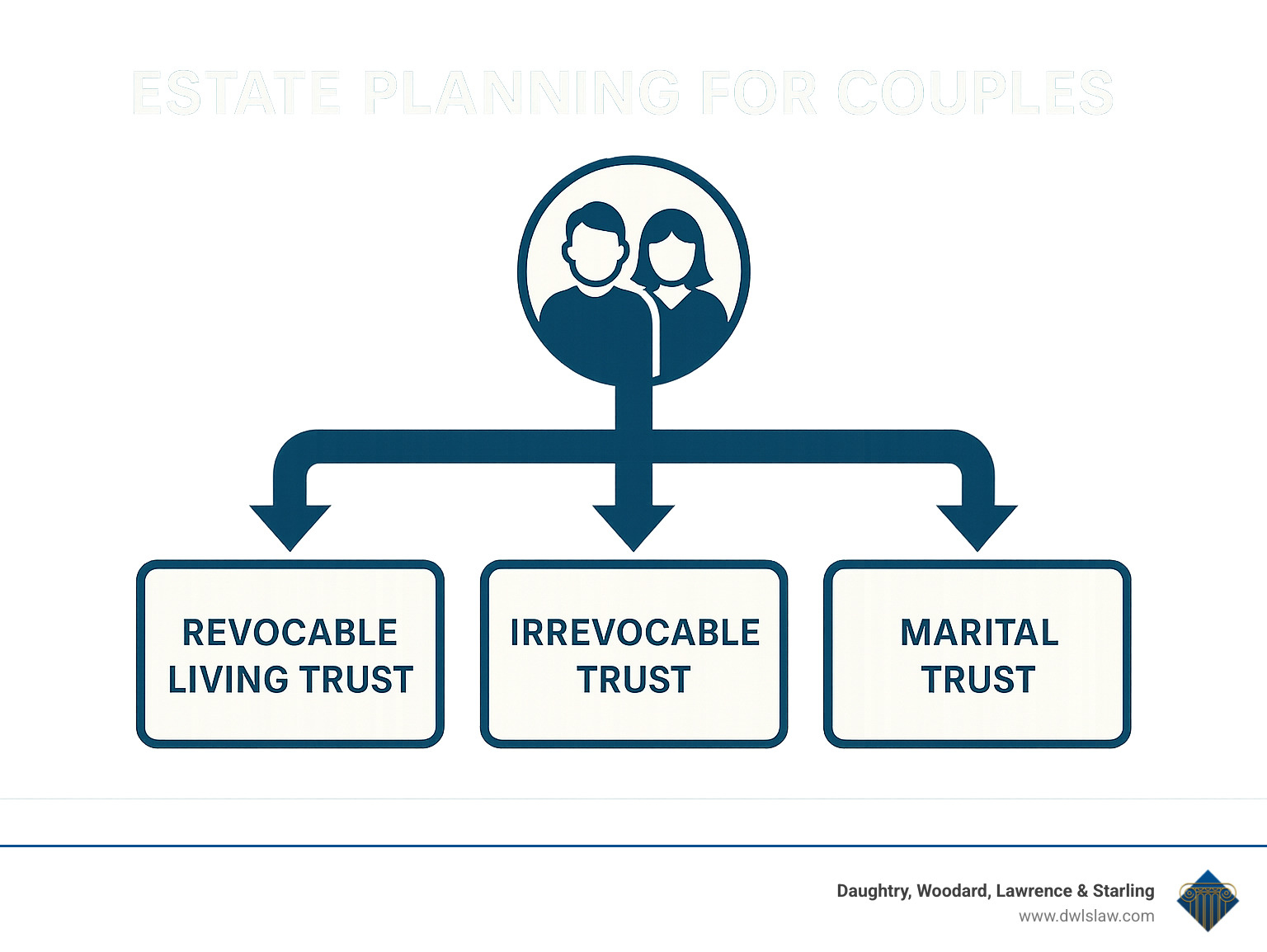
Trusts are like Swiss Army knives for estate planning for couples—versatile tools that serve multiple purposes depending on your needs:
Revocable Living Trust: Think of this as your estate planning command center. You maintain complete control during your lifetime, but if you become incapacitated, your chosen successor trustee steps in to manage things. After your death, assets transfer to your beneficiaries without the hassle, expense, and public exposure of probate. Want to learn more? Check out our article on What You Need to Know About a Revocable Trust.
Credit Shelter Trust (Bypass Trust): This clever tool helps married couples maximize their estate tax exemptions. When the first spouse passes away, assets up to the exemption amount go into this trust. The surviving spouse can benefit from the trust during their lifetime, but since the assets aren’t owned outright, they don’t get taxed in the second spouse’s estate—allowing both exemptions to be fully used.
Spousal Lifetime Access Trust (SLAT): This irrevocable trust offers a “have your cake and eat it too” approach. One spouse creates the trust for the other’s benefit, removing assets from their own estate while still allowing the family access to those assets through the beneficiary spouse.
Special Needs Trust: For couples with children or dependents who have disabilities, these specialized trusts provide financial support without jeopardizing eligibility for vital government benefits like Medicaid or SSI.
Asset Protection Trust: These trusts can shield your hard-earned assets from creditors, lawsuits, and other financial threats that might emerge down the road.
For a deeper dive into trust options, explore our guide on 4 Trusts to Incorporate Into an Estate Plan.
Minimizing Estate & Gift Taxes
If you’re among the couples whose estates exceed the exemption amounts, several strategies can help minimize the tax bite:
Portability Election is a true “use it or lose it” opportunity. If one spouse dies without using their full estate tax exemption, the executor must file an estate tax return to transfer the unused portion to the surviving spouse—even if no tax is due. Miss this filing, and you could leave millions of tax exemptions on the table.
Annual Exclusion Gifts allow each person to give up to $18,000 (in 2024) per recipient annually without touching their lifetime exemption. As a married couple, you can boost this to $36,000 per recipient each year—a powerful way to transfer wealth tax-free over time.
With the scheduled reduction in estate tax exemptions looming in 2026, many forward-thinking couples are creating Spousal Lifetime Access Trusts (SLATs) before the end of 2025 to lock in today’s higher exemption amounts before they disappear.
Charitable Strategies like charitable remainder trusts, charitable lead trusts, and donor-advised funds offer meaningful tax benefits while supporting the causes you care about—a true win-win.
Don’t forget State-Level Planning. While North Carolina repealed its estate tax in 2013 (thank goodness!), if you own property in other states, you might still face their estate or inheritance taxes, which often have much lower exemptions than federal taxes.
The right combination of these strategies, custom to your specific situation, can save your family significant taxes while ensuring your legacy goals are met. At Daughtry, Woodard, Lawrence & Starling, we help couples steer these complex waters with clarity and confidence.
A 7-Step Roadmap to Start Estate Planning as a Couple
Creating an estate plan together doesn’t have to feel overwhelming. In fact, approaching it as a team can strengthen your relationship while securing your future. Let’s walk through a practical roadmap to get you started:

1. Create an Asset Inventory
Begin your journey by sitting down together and creating a comprehensive list of everything you own. This includes your home and other real estate, bank accounts, investment portfolios, retirement funds, life insurance policies, business interests, and any personal items of significant value (think family heirlooms, art collections, or jewelry).
As you compile this list, note how each asset is titled—whether it’s in one person’s name, jointly held, or in a trust—and check if any already have designated beneficiaries. This inventory becomes your foundation for all future planning decisions.
2. Define Your Goals
Pour yourselves a cup of coffee (or perhaps something stronger) and have an honest conversation about what matters most to both of you. Who should inherit your assets? If you have children, who would raise them if something happened to both of you? Who do you trust to make medical or financial decisions if either of you becomes incapacitated?
Discuss whether specific items should go to particular people, if you want to support any charitable causes, and whether you have concerns about potential estate taxes. These shared goals will guide your entire planning process.
3. Schedule a Calm Conversation
Estate planning discussions touch on mortality, money, and family dynamics—all potentially sensitive topics. Set aside dedicated time in a peaceful environment with minimal distractions. Maybe plan a weekend morning at home or a quiet dinner out where you can speak privately.
It’s perfectly normal if emotions surface during these conversations. Approach each other with patience, empathy, and an open mind. The goal isn’t to “win” but to create a plan that honors both your wishes.
4. Choose Your Advisors
Estate planning for couples works best with professional guidance. Look for an experienced estate planning attorney who listens well and explains complex concepts in terms you both understand. For more complex situations, you might also want a financial advisor and an accountant on your team.
Choose professionals who have experience with your specific circumstances—whether that’s a blended family, a family business, or significant charitable goals. The right advisors will feel like partners in your planning process, not just service providers.
5. Draft Your Documents
Working with your attorney, you’ll create essential documents including wills, powers of attorney, and healthcare directives. Depending on your situation, you might also establish trusts for tax planning, probate avoidance, or special needs planning.
Take time to review these documents carefully together. Don’t hesitate to ask questions—these papers will direct your most important decisions, so you should fully understand what you’re signing.
6. Align Your Beneficiary Designations
Many people don’t realize that beneficiary designations on retirement accounts and life insurance policies override what’s in your will. Take time to update these designations to align with your overall estate plan.
This step is often overlooked but critically important—misaligned beneficiary designations are one of the most common reasons estate plans fail to work as intended.
7. Review Your Plan Regularly
Your estate plan isn’t a “set it and forget it” document. Life changes, laws evolve, and your wishes might shift over time. Make a date every two years to review your plan together, and don’t wait for that date if you experience major life events like having a child, moving to a new state, or receiving a substantial inheritance.
For more guidance on keeping your plan current, check out our article on When Should You Update Your Estate Plan?
Conversation Tips That Keep the Peace
Estate planning discussions can occasionally reveal different priorities between partners. Here are some thoughtful approaches to keep your conversations productive and harmonious:
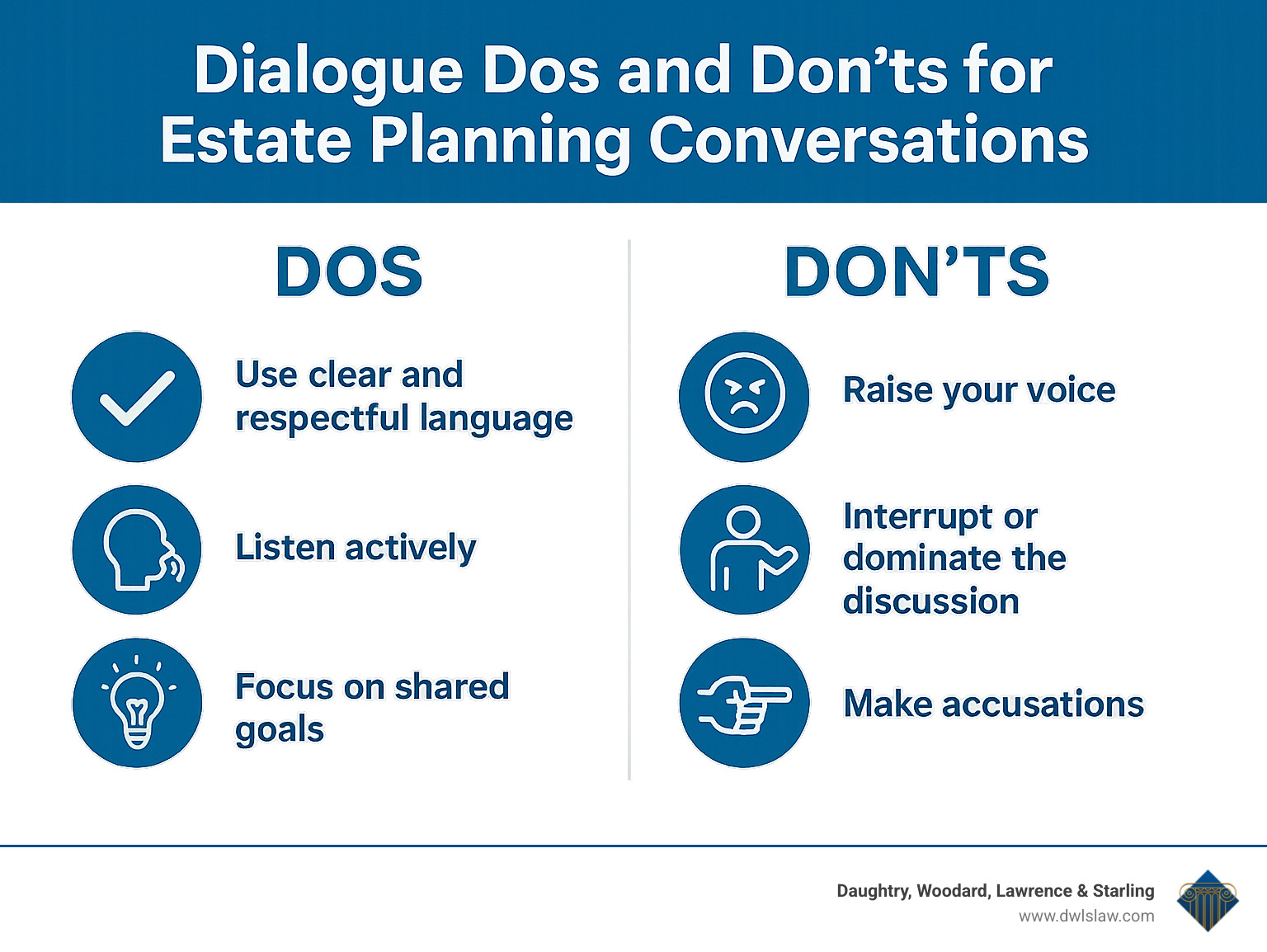
Choose a neutral setting where you both feel comfortable—perhaps over coffee on a relaxed weekend morning rather than after a stressful workday. Listen actively to understand each other’s concerns without immediately jumping to solutions or judgments.
Focus conversations on your shared goals and values. Most couples find they agree on the big picture—protecting each other, providing for loved ones, avoiding family conflict—even if they differ on specific details.
If you encounter disagreements, try creating individual lists of your top priorities, then look for creative compromises. Sometimes seeing priorities written down helps identify where flexibility might be possible.
These conversations aren’t about “winning”—they’re about creating a plan that honors both your wishes. If you find yourselves at an impasse, consider bringing in your estate planning attorney as a neutral mediator who can suggest solutions that address both partners’ concerns.
Keeping Your Plan Current Through Life Changes
Life doesn’t stand still, and neither should your estate plan. Certain events should trigger an immediate review:
Births or adoptions often change how you want your assets distributed and raise important guardianship considerations. Marriage or divorce necessitate a complete overhaul of your estate documents—in fact, divorce is one of the most commonly missed reasons to update an estate plan. For guidance after a divorce, see our article on What Should You Do About an Estate Plan After Divorce?
Business changes like starting a new venture, selling your company, or taking on partners create new planning needs. Receiving a substantial inheritance might open new planning opportunities or necessitate tax strategies you hadn’t previously considered.
Relocating across state lines means adapting to different laws governing everything from wills to marital property rights. And significant tax law changes can create both opportunities and challenges for your existing plan.
Even without these specific triggers, pencil a “plan review date” on your calendar every two years. Laws change, relationships evolve, and what seemed perfect when you first created your plan might need fine-tuning as your life together unfolds.
Frequently Asked Questions about Estate Planning for Couples
What happens if we don’t have a will as a couple?
The absence of a will creates what legal professionals call an “intestate” situation—and it’s rarely what couples would choose if they had a say in the matter.
In North Carolina, without a will, your assets follow a predetermined path based on our state’s intestacy laws. These laws create a one-size-fits-all approach that may not reflect your wishes at all:
If you’re married without children or living parents, your spouse inherits everything—which might align with your wishes. But the situation gets complicated quickly in other scenarios. With one child, your spouse receives only half your real estate plus the first $60,000 and half the remaining personal property, while your child receives the rest. With multiple children, your spouse’s share shrinks further to just one-third.
For unmarried couples, the consequences are even more serious—your partner has absolutely no inheritance rights under intestacy laws. Your assets would bypass your partner completely and go directly to blood relatives, potentially leaving your partner in a precarious financial situation.
Perhaps most concerning for parents: without a will naming guardians, a court will decide who raises your children if you both die, without any input from you about who would best honor your values and parenting style.
As I often tell clients at Daughtry, Woodard, Lawrence & Starling, estate planning for couples isn’t just about assets—it’s about protecting the people you love and ensuring your wishes are honored.
How often should we review our joint estate plan?
Life doesn’t stand still, and neither should your estate plan. I recommend couples review their estate plans:
Every two years as a standard practice, even when life seems relatively stable. Laws change, assets grow, and relationships evolve in ways we sometimes don’t immediately recognize.
After major life transitions like marriages, divorces, births, or deaths in the family. These milestone moments fundamentally change your family structure and often necessitate updates to your planning documents.
When your financial situation changes significantly—perhaps through a job change, business sale, inheritance, or major investment gains or losses.
After moving to a new state, as estate planning laws vary significantly across state lines.
Following significant tax law changes that might impact your estate planning strategy.
Regular reviews ensure your estate planning for couples documents continue to reflect your current wishes and take advantage of the latest legal protections available. I’ve seen too many families find outdated documents during a crisis—when it’s too late to make changes.
Can beneficiary designations override our wills?
Absolutely—and this surprises many couples. Your carefully crafted will has no power over assets with beneficiary designations. These designations create a separate path for assets to transfer directly to named beneficiaries, completely bypassing your will.
This includes life insurance policies, retirement accounts (like 401(k)s and IRAs), transfer-on-death investment accounts, and payable-on-death bank accounts. These assets go directly to whoever is named on the beneficiary form—regardless of what your will states.
This can work in your favor when properly coordinated with your overall plan. Direct beneficiary transfers avoid probate, potentially saving time and money. However, outdated designations can create unintended consequences and even family conflicts.
I’ve seen cases where a client never updated their life insurance beneficiary after marriage, leaving their parents rather than their spouse to receive a substantial payout—despite having a will that left everything to their spouse. By the time this oversight was finded after death, it was too late to correct.
That’s why comprehensive estate planning for couples should include a thorough review of all beneficiary designations to ensure they align with your overall intentions. These simple forms often control more of your assets than your will does, making them a crucial component of your estate plan.
Conclusion
Estate planning for couples is about much more than just preparing for the inevitable—it’s about protecting each other, securing your family’s future, and ensuring your wishes are honored. By creating a comprehensive plan together, you can:
- Protect each other in case of incapacity
- Ensure your assets go to your chosen beneficiaries
- Provide for your children’s care and financial security
- Minimize taxes and avoid probate
- Prevent family conflicts and legal challenges
- Create peace of mind for yourselves and your loved ones
At Daughtry, Woodard, Lawrence & Starling, we understand that every couple’s situation is unique. Whether you’re married or unmarried, have a traditional or blended family, or face simple or complex financial circumstances, we can help you create an estate plan custom to your specific needs and goals.
Our experienced attorneys serve clients throughout North Carolina, including Smithfield, Clinton, and Sampson County. We pride ourselves on providing compassionate, knowledgeable guidance through the estate planning process, making it as straightforward and stress-free as possible.
Don’t leave your family’s future to chance. Contact us today to schedule a consultation and take the first step toward creating a comprehensive estate plan that protects you, your partner, and your loved ones for years to come.
For more information about our estate planning services, visit our estate planning practice page.