

Navigating the Emotional and Legal Maze of Child Custody
A Child custody dispute attorney is a family-law lawyer who helps parents resolve where children will live, how important decisions will be made, and when each parent will spend time with the child. Their role is multifaceted, providing critical support through every stage of the process.
Key services a child custody dispute attorney provides include:
- Courtroom and Negotiation Representation: Your attorney acts as your advocate, whether you are negotiating a settlement with the other parent’s lawyer or presenting your case before a judge. They can shift from a collaborative negotiation style to assertive litigation tactics as the situation demands, always protecting your interests.
- Drafting Custody Petitions and Parenting Plans: The legal documents in a custody case must be precise. An attorney ensures that petitions are filed correctly and that parenting plans are comprehensive, covering everything from weekly schedules to holiday arrangements and decision-making protocols to prevent future conflicts.
- Mediation Preparation: Before you meet with a neutral mediator, your lawyer will help you define your goals, understand the legal parameters, and anticipate the other party’s arguments. This preparation empowers you to negotiate effectively and work towards a favorable agreement.
- Gathering and Presenting Evidence: A strong case is built on solid evidence. Your attorney will help you collect and organize crucial documentation, such as emails, text messages, school records, financial statements, and witness testimony, and present it compellingly to support your position.
- Safeguarding Parental Rights: An attorney works to ensure your fundamental rights as a parent are protected. This includes your right to have a meaningful relationship with your child and your right to participate in major decisions regarding their upbringing, health, and education.
- Offering Realistic, Objective Guidance: The emotional turmoil of a custody dispute can cloud judgment. An attorney provides a clear-headed, objective perspective, helping you understand the strengths and weaknesses of your case and advising you on the most strategic path forward, free from emotional bias.
North Carolina requires most parents to try mediation before heading to court, and judges decide custody using a single question: “What arrangement best serves the child’s interests?” Legal fees in contested cases can reach tens of thousands of dollars, so having clear direction from the start matters.
I’m Kelly K. Daughtry. For over five decades my colleagues and I at Daughtry, Woodard, Lawrence & Starling have guided families in Smithfield, Clinton, and throughout Sampson County through these decisions with compassion and steady legal skill.
Child custody dispute attorney vocab explained:
- Bilingual family law attorney
- Board certified family lawyer
Understanding the Battlefield: Key Concepts and Why You Need a Child Custody Dispute Attorney
1. The “Best Interest of the Child” Rule

Courts in North Carolina are guided by a single, paramount principle: the “best interest of the child.” This is not a simple checklist but a holistic evaluation of numerous factors to determine which parent can provide the most stable, nurturing, and beneficial environment. A judge will weigh evidence related to:
- Child’s Age, Health, and Developmental Needs: The needs of an infant are vastly different from those of a teenager. The court considers which parent is better equipped to handle the specific stage of the child’s life, from managing a toddler’s routine to guiding a high schooler through academic and social challenges.
- History of Day-to-Day Care: The judge will look at which parent was the primary caregiver before the separation. This includes tasks like preparing meals, helping with homework, arranging medical appointments, and participating in school activities. This history demonstrates a parent’s established role in the child’s life.
- Each Parent’s Home Environment and Stability: The court assesses the stability each parent can offer. This includes not just physical housing but also factors like a parent’s work schedule, financial stability, and the presence of a supportive network of family and friends.
- Strength of the Parent-Child Bond: The emotional ties between a parent and child are crucial. The court looks for evidence of a loving, affectionate, and supportive relationship. This can be demonstrated through testimony, photos, and the child’s own expressed wishes (depending on their age and maturity).
- Willingness to Foster the Child’s Relationship with the Other Parent: Courts strongly favor parents who encourage and support the child’s relationship with the other parent. A parent who actively undermines the other parent or engages in parental alienation may be viewed unfavorably by the judge, as this is seen as detrimental to the child’s well-being.
There is no automatic preference for mothers or fathers in North Carolina. The judge reviews evidence and crafts the plan that promotes safety, stability, and healthy growth. More info
2. Legal vs. Physical Custody & Parenting Plans
| Legal Custody (decisions) | Physical Custody (residence) |
|---|---|
| Education, health care, religion | Where the child lives day-to-day |
| Sole or joint | Primary, shared, or visitation |
A solid parenting plan spells out:
- Weekly schedule and exchange logistics
- Decision-making methods (joint, sole, tie-breaker)
- Holiday/summer rotations
- Communication rules between parents
3. Paths to Resolution

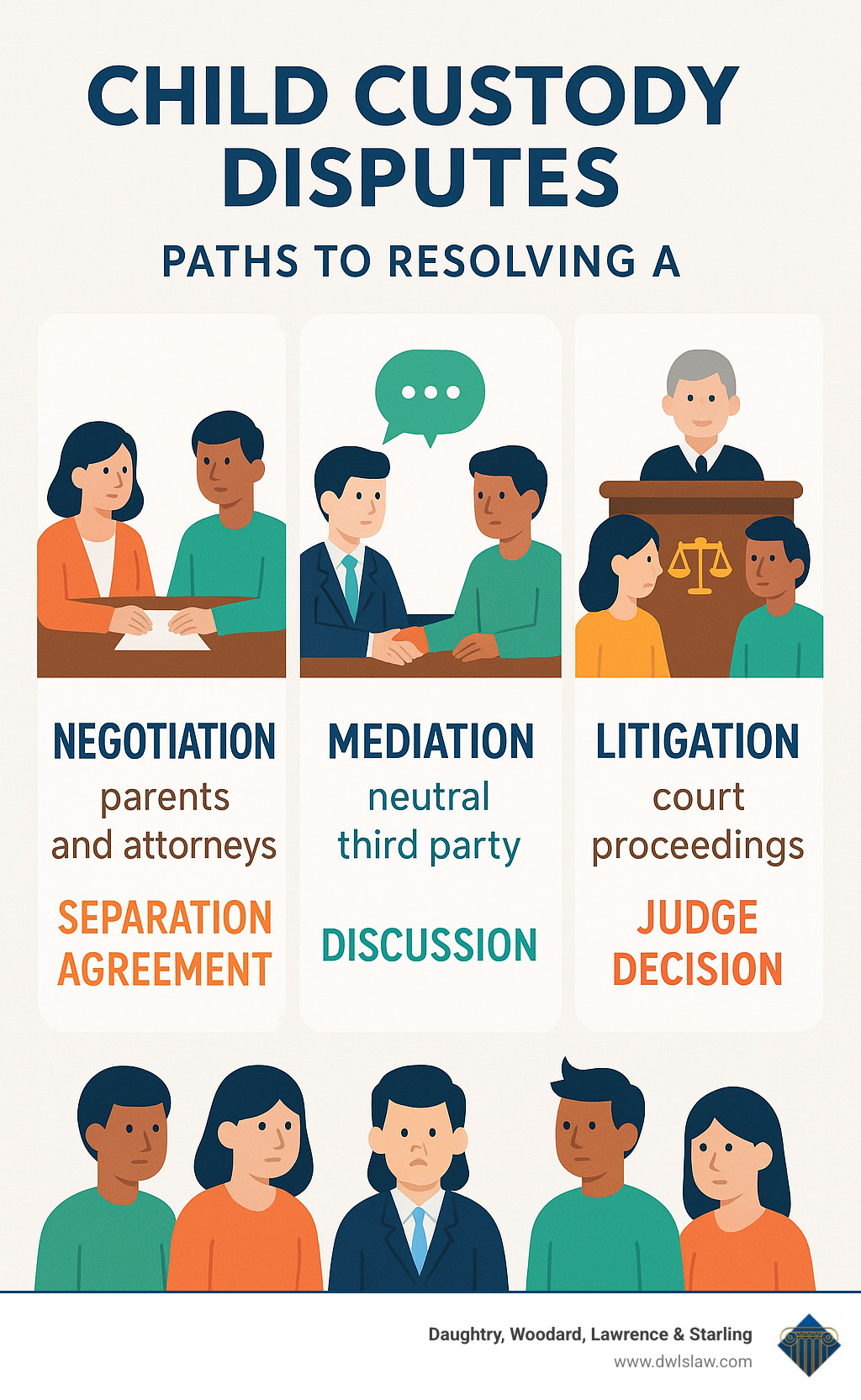
There are three primary avenues for resolving custody disputes in North Carolina, each with distinct advantages and disadvantages.
- Negotiated Agreement: This is often the most desirable path. The parents, usually with the help of their respective attorneys, work together to create a parenting agreement outside of court. This process is private, flexible, and gives parents the most control over the outcome. The final agreement, once signed, is a legally binding contract.
- Mediation: In most North Carolina counties, mediation is a mandatory step before you can go to court. A neutral, third-party mediator facilitates a structured conversation between the parents to help them find common ground and create their own custody agreement. The mediator does not make decisions but guides the process. If an agreement is reached, it can be formalized into a legally enforceable consent order.
- Litigation: When negotiation and mediation fail, the dispute proceeds to litigation. This is a formal court process where both sides present evidence and arguments to a judge. The judge then makes a final, binding decision based on the “best interest of the child” standard. While litigation provides a definitive resolution, it is often the most expensive, time-consuming, and emotionally taxing option, and it places the final decision in the hands of a third party rather than the parents.
4. How an Attorney Helps
- Tailors a strategy that matches your goals and the facts
- Drafts and files every court document on time
- Collects records, photos, and witness statements to prove your involvement
- Negotiates settlements; represents you at trial if needed
- Keeps focus on long-term child welfare, not short-term emotion
What to share with your lawyer
5. Choosing Your Lawyer

Ask at your consultation:
- How many custody matters have you handled this year?
- Do you hold board certification in family law?
- What is your communication response time?
- What is your fee structure and estimated total cost?
6. Child Support, Costs & Protecting Kids
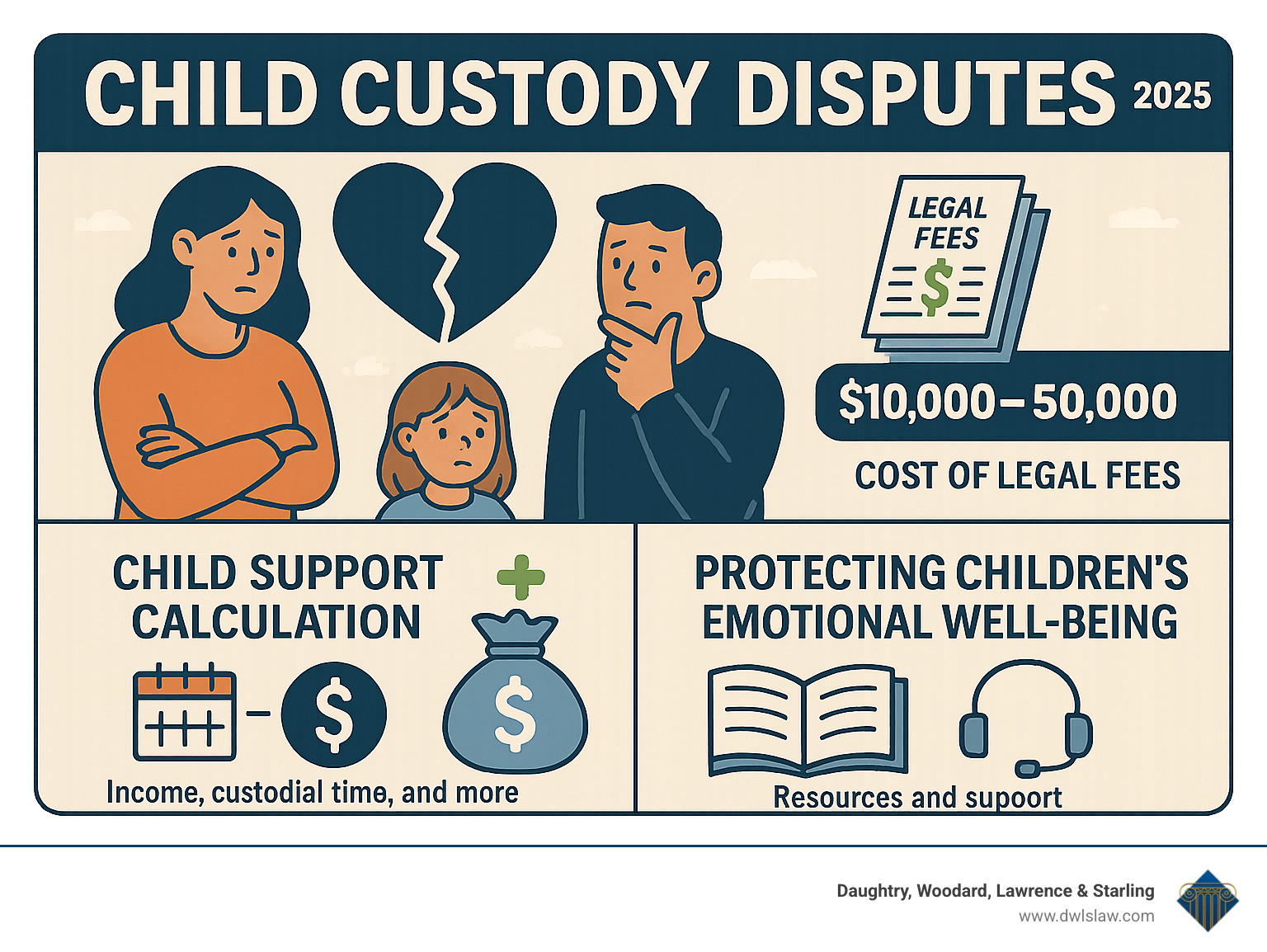
- Both parents must support their children financially; guidelines use both incomes, health-insurance costs, and childcare expenses.
- Visitation and support are legally separate: missing payments does not cancel visitation, and vice versa.
- Legal fees range widely ($10,000–$50,000+) depending on complexity and conflict level.
- Shield children from adult disputes, keep routines steady, and consider counseling if stress shows.
- Courts may appoint a Guardian ad Litem when impartial input is needed. This person is a specially trained advocate whose job is to investigate the family’s situation and make an independent recommendation to the court about what is in the child’s best interest.
- Document any signs of parental alienation—a pattern of behavior where one parent attempts to damage the child’s relationship with the other parent—and discuss them with your attorney immediately.
Support modification basics | Parenting after separation
Securing a Stable Future for Your Children
Custody battles can feel overwhelming, but they are temporary. Informed choices today create the foundation your children will stand on tomorrow.
At Daughtry, Woodard, Lawrence & Starling we combine decades of family-law experience, board-certified attorneys, and bilingual staff to guide families in Smithfield, Clinton, and across Sampson County.
The next step is simple: talk with a lawyer who can protect your parental rights and keep your children’s interests front and center. Every day you delay is a day of uncertainty for your family.
Contact a child custody lawyer to discuss your case
Your children deserve stability, safety, and love—let’s work together to build it.
Frequently Asked Questions
When should I hire a child custody dispute attorney?
You should hire a child custody dispute attorney as early as possible, ideally before mediation or filing court petitions, to protect your parental rights and build a strong case.
How can a child custody dispute attorney help with mediation?
A child custody dispute attorney prepares you for mediation by defining goals, reviewing legal parameters, anticipating arguments, and ensuring any agreement protects your child’s best interests.
What is the difference between legal and physical custody?
Legal custody refers to decision-making authority over a child’s education, health, and religion, while physical custody determines where the child lives day-to-day. A child custody dispute attorney ensures both are clearly addressed in a parenting plan.
How does a child custody dispute attorney gather evidence?
They help collect and organize crucial documentation, including emails, texts, school records, financial statements, and witness testimony, to present a compelling case to the court.
Can a child custody dispute attorney help protect parental rights?
Yes. They safeguard your right to a meaningful relationship with your child, ensure your voice in major decisions, and prevent parental alienation or other harmful actions from the other parent.


