
Board Certified Family Lawyer: Your Roadmap to Confident Representation
Understanding board certification in family law requires examining the rigorous standards that separate these attorneys from general practitioners. The journey to becoming a board certified family lawyer involves multiple layers of verification, testing, and ongoing education that ensure only the most qualified attorneys earn this distinction.
The certification process varies by state but maintains consistently high standards. In Texas, Board certified family lawyers must complete at least 60 hours of continuing legal education, significantly more than the standard requirements for general practice. Florida’s criteria include handling at least 25 contested marital and family law cases in the five years preceding application, with at least seven trials. North Carolina requires an average of 600 hours per year in family law practice over five years, with no fewer than 400 hours in any single year.
These requirements reflect the complexity of modern family law. Recent trends show increasing sophistication in family law matters, from high-asset divorces involving complex financial instruments to custody arrangements that must account for modern family structures. The peer review process ensures that Board certified family lawyer maintain not only technical competence but also ethical standards and professional reputation.
California’s three-year renewal cycle demonstrates the ongoing commitment required. Board certified family lawyer must continuously prove their dedication to the field through advanced continuing education, often double the requirements of general practitioners. This ensures that certified attorneys stay current with evolving family law, including recent legislative changes like the Respect for Marriage Act and shifting court interpretations of custody and property division.
Path to Becoming a Board Certified Family Lawyer
The journey to board certification begins with a minimum five-year practice requirement, but the real work involves demonstrating substantial involvement in family law cases. Candidates must prove they’ve dedicated significant time to family law practice, not just occasional cases mixed with other legal work.
The written examination represents a crucial hurdle. Unlike the general bar exam, this test focuses exclusively on family law nuances, from complex property division calculations to intricate custody law applications. The exam covers areas that general practitioners might encounter only occasionally but that certified attorneys handle regularly.
Continuing legal education requirements exceed standard bar maintenance. Texas requires 60 hours of CLE over five years, while North Carolina mandates 45 hours within three years, with at least nine hours per calendar year. Florida demands 75 hours of approved continuing legal education in the five years preceding application. These requirements ensure certified attorneys stay current with rapidly evolving family law.
Peer references provide crucial validation. Ten licensed attorneys or judges must attest to the candidate’s competence, with specific restrictions preventing references from relatives or colleagues. This peer review process ensures that board certification reflects not just academic achievement but practical competence recognized by the legal community.
The recertification cycle varies by state but typically occurs every three to five years. This ongoing requirement means that board certification isn’t a one-time achievement but a continuous commitment to maintaining the highest standards in family law practice. More info about Board Certified Family Attorney
Board Certified Family Lawyer vs. General Practitioner
The distinction between board certified and general family law attorneys extends far beyond credentials. Board certified attorneys must demonstrate substantial involvement in family law, typically requiring 50% or more of their practice time devoted to family matters. This focused practice creates depth of experience that general practitioners, who might handle family law alongside other areas, cannot match.
| Aspect | Board Certified Family Lawyer | General Family Law Attorney |
|---|---|---|
| Practice Focus | Minimum 50% family law practice | May handle family law part-time |
| Trial Experience | Minimum 7-25 contested trials required | No specific trial requirements |
| Continuing Education | 45-75 hours family law CLE | Standard bar CLE requirements |
| Peer Review | Required references from 10 attorneys/judges | No peer review requirement |
| Examination | Must pass advanced family law exam | Only general bar exam required |
| Recertification | Every 3-5 years with ongoing requirements | No recertification needed |
Caseload depth makes a significant difference in complex matters. Board certified attorneys must handle substantial numbers of contested cases, providing experience with high-conflict situations that general practitioners might avoid. Florida’s requirement of at least 25 contested cases with seven trials ensures certified attorneys have courtroom experience when negotiations fail.
The renewal requirements create ongoing accountability. While general practitioners need only maintain basic bar membership, board certified attorneys must continuously prove their commitment to family law through advanced education and peer review. This creates a dynamic where certified attorneys stay current with emerging trends and legal developments.
Client benefits extend beyond technical competence. Board certified attorneys typically maintain relationships with other family law professionals, including forensic accountants, child psychologists, and mediators. This network proves invaluable in complex cases requiring interdisciplinary approaches.
State Certification Requirements at a Glance
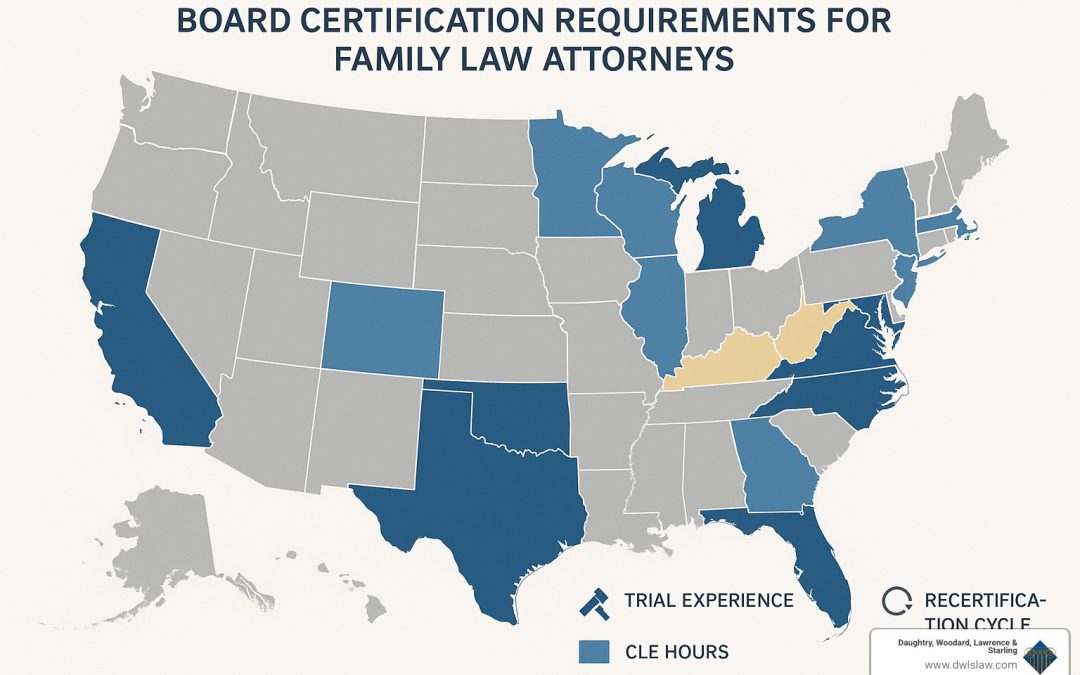
State-by-state requirements reveal the geographic differences in board certification standards. Florida’s 25 contested cases requirement reflects the state’s emphasis on trial experience, while North Carolina’s 600-hour annual requirement focuses on practice volume. Texas, with only 6,800 certified attorneys out of 120,000 licensed lawyers, maintains exclusivity through comprehensive requirements.
Florida’s August 31 deadline for initial applications creates a specific window for candidates, with applications accepted only between July 1 and August 31. This timing allows the Florida Bar to process applications systematically while maintaining quality control. The state’s directory lists 278 board-certified marital and family law attorneys, demonstrating the selectivity of the process.
California’s three-year renewal cycle, shorter than most states, reflects the state’s commitment to ensuring certified attorneys maintain current knowledge. The state’s diverse legal landscape, from Silicon Valley technology divorces to Hollywood entertainment law family matters, requires attorneys to stay current with rapidly evolving legal and financial instruments.
Judicial eligibility represents an interesting aspect of certification. Florida explicitly allows judicial officers who regularly preside over family law matters to seek board certification. This recognition acknowledges that judges develop substantial family law knowledge through their judicial service, though they must still meet the same rigorous standards as practicing attorneys.
The geographic differences reflect varying state priorities. States with large urban populations tend to emphasize trial experience, recognizing that complex family matters often require courtroom resolution. Rural states might focus more on practice hours, ensuring certified attorneys have broad experience across different types of family law matters.
Why Clients Choose Board Certification for Complex Family Matters
High-asset divorces present unique challenges that board certified attorneys handle regularly. These cases often involve complex financial instruments, business valuations, and international assets that require sophisticated legal knowledge. The advanced continuing education requirements ensure certified attorneys stay current with evolving financial law and tax implications.
Child custody battles benefit significantly from certified representation. The requirement for substantial trial experience means board certified attorneys have courtroom skills for high-conflict custody disputes. They understand the nuances of custody evaluations, the role of guardians ad litem, and strategies for protecting children’s interests during contentious proceedings.
Domestic violence orders require immediate action and comprehensive understanding of protective order procedures. Board certified attorneys typically maintain relationships with law enforcement, social services, and victim advocacy groups. Their experience with emergency proceedings can be crucial when client safety is at stake.
Adoption processes involve complex legal requirements that vary significantly by adoption type. Whether handling stepparent adoptions, international adoptions, or contested adoption proceedings, board certified attorneys understand the intricate legal requirements and potential complications that can arise.
Mediation options often work better with certified attorneys who understand both collaborative approaches and trial preparation. Their comprehensive knowledge allows them to evaluate settlement proposals effectively while maintaining the ability to proceed to trial if necessary. More info about Child Custody Lawyer
Ethical safeguards built into board certification provide additional client protection. The peer review process and ongoing education requirements create accountability that extends beyond basic bar discipline. Certified attorneys understand they must maintain not only legal competence but also professional reputation within the family law community.
How to Locate and Confirm Credentials
Bar directories provide the most reliable method for locating and verifying board certified family attorneys. Each state maintains official directories that list certified attorneys with current status, practice locations, and contact information. These directories undergo regular updates to ensure accuracy.
Texas offers a comprehensive lookup tool through the Texas Board of Legal Specialization website. Users can search by attorney name, city, county, or zip code across 28 practice areas, including family law. The directory provides detailed information about each certified attorney’s qualifications and current status.
Florida’s directory currently lists 278 board-certified marital and family law attorneys, with searchable fields for name, city, and county. The Florida Bar’s certification directory provides not only contact information but also additional certifications an attorney might hold, such as civil trial or business litigation.
The American Academy of Matrimonial Lawyers (AAML) offers another valuable resource for locating qualified family law attorneys. While AAML membership differs from state board certification, it provides additional verification of an attorney’s commitment to family law practice. Scientific research on legal directory usefulness
Peer reviews available through various legal rating services can supplement official directories. However, these should be used in conjunction with, not as replacement for, official board certification verification. The peer review process built into board certification provides more rigorous evaluation than general rating services.
Certification badges and official documentation provide verification steps that clients should request. Board certified attorneys typically display their certification prominently on websites and marketing materials. However, clients should verify this information through official state bar directories rather than relying solely on attorney representations.
The verification process involves several steps: confirming current bar membership, checking disciplinary history, verifying board certification status, and confirming the attorney’s practice focus aligns with your specific needs. This due diligence ensures you’re working with an attorney who meets the highest standards in family law practice.
Ready to Protect Your Family’s Future?

When your family’s future hangs in the balance, you need more than just any attorney – you need someone who truly understands the complexities of family law. At Daughtry, Woodard, Lawrence & Starling, we know that family law matters touch the most precious parts of your life: your children, your home, and your peace of mind.
Finding the right board certified family lawyer doesn’t have to feel overwhelming. Our consultation process starts with listening to your story and understanding what matters most to you. We believe you deserve to know not just what we recommend, but why we think it’s the best path forward.
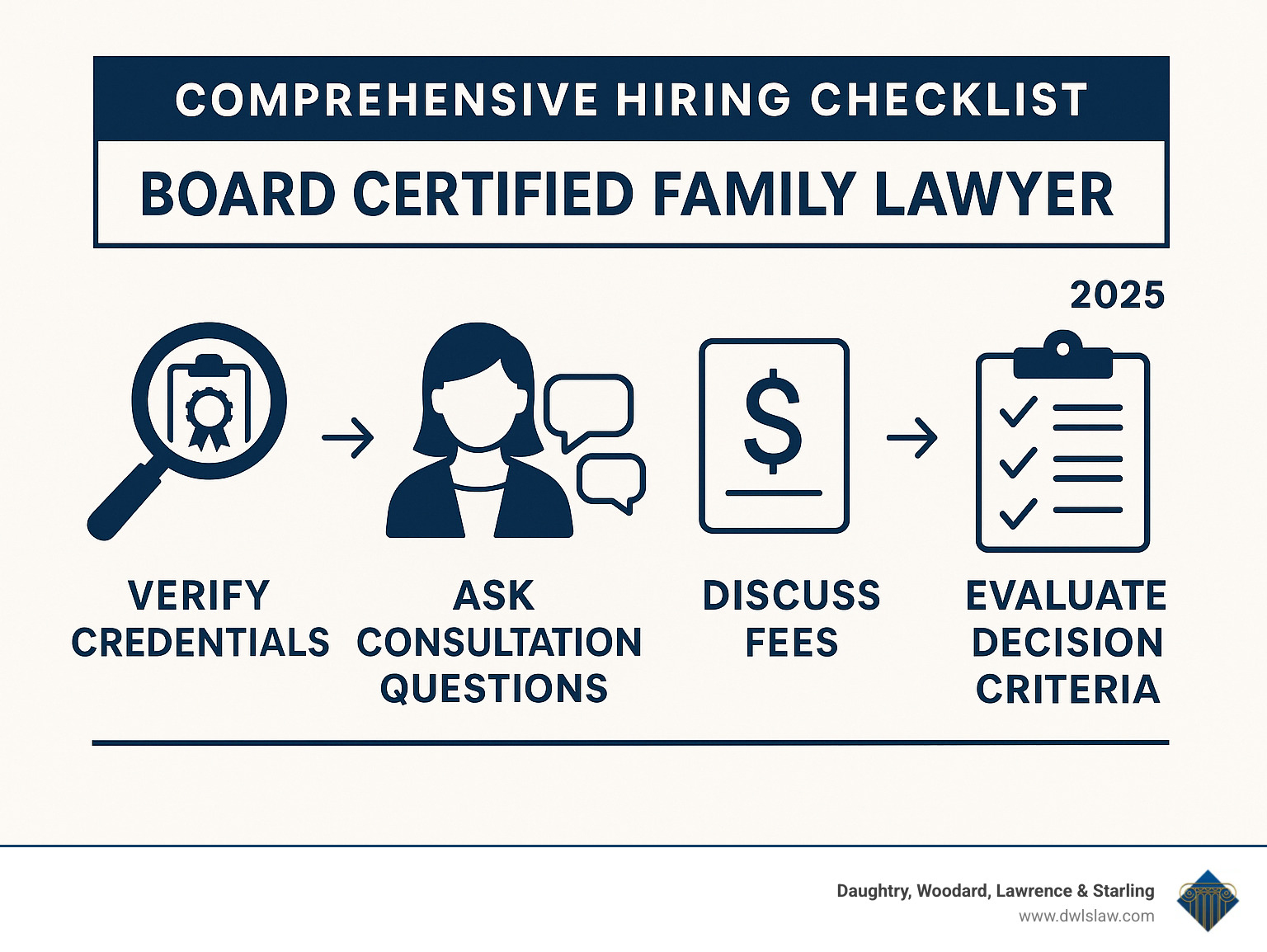
Your hiring checklist should include several key steps. First, verify that your attorney holds current board certification – this ensures they’ve met the rigorous standards we’ve discussed throughout this guide. Ask about their experience with cases similar to yours, because every family situation is unique. Discuss fee structures upfront so there are no surprises later. Most importantly, trust your instincts about whether you feel comfortable working with this person during what might be a challenging time.
At our firm, we understand that board certification is more than just a credential – it’s a promise. It means we’ve committed to the ongoing education, peer review, and trial experience that complex family matters demand. Whether you’re facing a high-asset divorce, fighting for custody of your children, or dealing with domestic violence, we bring the knowledge that comes from focused practice in family law.
The peace of mind that comes with board certified representation often makes the difference between a stressful legal process and one where you feel confident and supported. We maintain the continuing education requirements, professional relationships, and courtroom experience that your case deserves. More info about Board Certified Family Attorney
Family crises don’t wait for convenient timing, and neither should your legal representation. If you’re facing a family law issue, we encourage you to schedule a consultation to discuss your situation. Our family law offices in Smithfield and Clinton serve families throughout North Carolina, providing the experienced, compassionate representation that your family’s future deserves.
The investment in board certified representation often pays for itself through better outcomes, more efficient resolution, and the confidence that comes from knowing you have the right attorney on your side. When your family’s future is at stake, the real question isn’t whether you can afford board certified representation – it’s whether you can afford not to have it.
Frequently Asked Questions
How does a board certified family lawyer differ from a general family law attorney?
Board certified attorneys must dedicate at least 50% of their practice to family law, complete significantly more CLE hours, pass an advanced exam, obtain peer reviews, and meet strict recertification requirements—standards general practitioners do not have to meet.
What are the benefits of hiring a board certified family lawyer?
Clients gain the advantage of specialized knowledge, substantial trial experience, and up-to-date training on complex family law issues such as high-asset divorce, custody disputes, domestic violence, and adoption. Their expertise often results in better case outcomes.
Why is trial experience important in family law cases?
Many complex cases—such as high-conflict custody or property division matters—require courtroom litigation. Board certified attorneys have mandatory trial experience, ensuring they can manage contested hearings effectively when negotiations fail.
How do I verify if an attorney is board certified?
You can check state bar certification directories, such as those offered by Texas, Florida, North Carolina, or California. These directories list current certification status, practice details, and disciplinary history.
Are board certified family lawyers required to maintain their certification?
Yes. States require recertification every 3–5 years. Attorneys must show ongoing education, continued substantial involvement in family law, and positive peer evaluations to maintain their status.


