

Why Finding the Right Divorce Attorney in Smithfield, NC Matters
If you need a divorce attorney smithfield nc, you’re likely facing one of life’s most challenging transitions. The good news? Johnston County has experienced family law attorneys who can guide you through North Carolina’s divorce process with compassion and expertise.
Top Divorce Attorneys in Smithfield, NC:
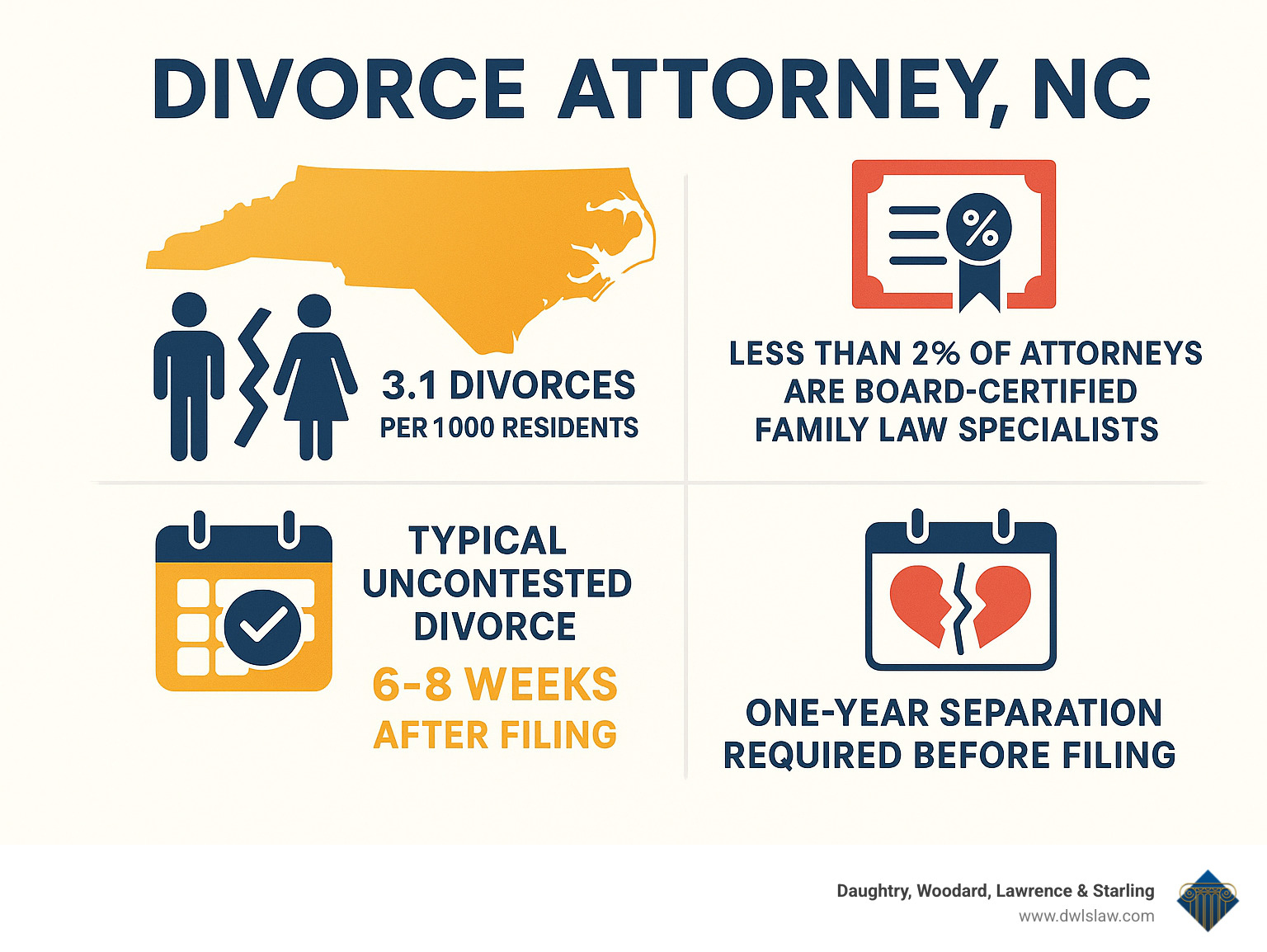
– Board-certified family law specialists (less than 2% of NC attorneys hold this certification)
– Local attorneys with Johnston County courtroom experience
– Bilingual support available at several firms
– Free or low-cost initial consultations offered by many practices
– Experience with both contested and uncontested divorces
North Carolina requires a one-year separation before filing for divorce, but you can address custody, child support, and property division immediately upon separation. The typical divorce timeline in Smithfield is 6-8 weeks after filing, provided all requirements are met.
Whether you’re dealing with child custody disputes, complex asset division, or simply need guidance through an uncontested divorce, choosing the right legal representation can make all the difference in protecting your rights and your family’s future.
I’m Kelly K. Daughtry, and I’ve been helping families steer divorce and family law matters in Smithfield and Johnston County for decades through our full-service practice at Daughtry, Woodard, Lawrence & Starling. Our team understands the unique challenges facing those seeking a divorce attorney smithfield nc and we’re committed to providing personalized legal solutions custom to each family’s needs.

North Carolina Divorce 101: Residency, Separation & Grounds
Getting a divorce in North Carolina isn’t as simple as just deciding you want one. The state has specific requirements that must be met, and honestly, they can be a bit tricky to steer without proper guidance. Whether you’re just starting to consider divorce or you’re ready to move forward, understanding these basics will help you avoid costly delays and mistakes.
Residency & Separation Rules
Before any divorce attorney smithfield nc can file your case, North Carolina needs to have the legal authority to handle your divorce. This means at least one spouse must have called North Carolina home for six months before filing. It doesn’t matter if the other spouse lives out of state – as long as one of you meets this residency requirement, you’re good to go.
Here’s where it gets more complicated: you must live separately and apart for one full year before you can file for absolute divorce. This isn’t just about sleeping in different bedrooms or taking a trial separation. North Carolina law requires genuine separation with the intent to end the marriage permanently.
Living separately means maintaining completely separate households. You can’t share the same apartment, house, or even a mother-in-law suite during your separation year. The separation must be continuous, and both of you need to understand that at least one spouse intends for this separation to be permanent.
The biggest cohabitation pitfall many couples face is thinking they can “try again” during their separation year. If you reconcile and live together as husband and wife – even for just a weekend – your one-year clock resets to zero. Yes, this means you’d have to start the entire separation period over again. It’s heartbreaking when couples don’t realize this and end up adding months or even years to their divorce timeline.
Legal Grounds & Key Terminology
North Carolina keeps divorce relatively straightforward by offering two main options, though most people will pursue an absolute divorce. This is the complete dissolution of your marriage that allows both spouses to remarry if they choose. The only requirement? That one-year separation we just discussed.
The second option, divorce from bed and board, is essentially a legal separation that doesn’t allow remarriage. This might be chosen for religious reasons or when fault grounds exist, such as abandonment or cruel treatment. However, most couples seeking a divorce attorney smithfield nc are looking for absolute divorce.
Equitable distribution (ED) is how North Carolina handles property division, and it’s not what many people expect. Unlike states that automatically split everything 50/50, North Carolina courts aim for what’s “fair” based on your specific circumstances. The court considers factors like how long you were married, each spouse’s income and earning potential, your ages and health, and what each person contributed to the marriage – including non-financial contributions like homemaking and child-rearing.
Alimony is another area where North Carolina takes a nuanced approach. The court looks at whether one spouse needs financial support and whether the other spouse can afford to provide it. There’s temporary post-separation support that can help during the divorce process, and potentially longer-term alimony depending on your situation.
These rules might seem overwhelming, but that’s exactly why having experienced legal guidance makes such a difference. For a more detailed breakdown of the entire process, you can explore our comprehensive guide on 5 steps to file for divorce in NC.
Divorce Attorney Smithfield NC: How to Choose the Right Advocate
Finding the right divorce attorney smithfield nc can feel overwhelming when you’re already dealing with the emotional stress of ending a marriage. But choosing wisely now can save you time, money, and heartache down the road.
Think of your divorce attorney as your guide through unfamiliar territory. You want someone who knows the local landscape, speaks your language, and genuinely cares about getting you to your destination safely.
Board certification is like having a specialist rather than a general practitioner handle your case. The North Carolina State Bar Board of Legal Specialization only certifies family law attorneys who demonstrate exceptional knowledge and experience. With less than 2% of all family law practitioners in North Carolina holding this prestigious certification, it’s a credential worth seeking out when your future is on the line.
Local courtroom experience makes a real difference in Johnston County. An attorney who regularly appears before local family court judges understands the unique preferences and procedures that can impact your case. They know which judge prefers detailed financial affidavits and which one values concise presentations. This insider knowledge helps them advocate more effectively for you.
Mediation skills have become increasingly valuable as courts encourage families to resolve disputes outside the courtroom. An attorney trained in mediation can help you find common ground with your spouse, potentially saving thousands in legal fees while reducing the emotional toll on your family. It’s especially important when children are involved.
Bilingual staff can be a game-changer if English isn’t your first language. Clear communication with your legal team is essential, and several Smithfield firms recognize this by offering bilingual support throughout the legal process.
When you’re evaluating potential attorneys, pay attention to their fee structures and how they handle initial consultations. Many attorneys offer free or low-cost first meetings, giving you a chance to see if you feel comfortable working together. Trust your instincts – you’ll be sharing very personal information with this person.
For specialized expertise in complex divorce matters, consider our Board Certified Divorce Lawyer services.
Services a Smithfield Divorce Lawyer Provides
A comprehensive divorce attorney smithfield nc should offer much more than just filing paperwork. You need someone who can handle every aspect of your family’s transition.
Custody actions involve much more than deciding where your children will sleep each night. Your attorney should help develop parenting plans that truly serve your children’s best interests while protecting your rights as a parent. This includes working out custody schedules that fit your family’s reality, determining who makes important decisions about education and healthcare, and creating visitation arrangements that work for everyone.
Child support calculations might seem straightforward, but North Carolina’s Child Support Guidelines have nuances that can significantly impact the final amount. Your attorney should ensure the calculations are accurate and that proper enforcement mechanisms are in place so you actually receive the support ordered.
Property division through equitable distribution can get complicated quickly. Your attorney needs to identify all marital assets and debts, arrange proper valuations when necessary, and advocate for a fair division. This might involve appraising businesses, dividing retirement accounts, or determining how to handle the family home.
Alimony petitions require careful evaluation of multiple factors under North Carolina law. Your attorney should assess whether spousal support is appropriate in your situation and advocate for terms that reflect your actual financial needs and circumstances.
Domestic violence protective orders require immediate attention when abuse is present. Your attorney should know how to quickly obtain emergency protection while integrating safety planning into your overall divorce strategy.
Settlement drafting can help you avoid lengthy court battles by negotiating comprehensive separation agreements that address every aspect of your divorce. A well-drafted agreement saves time, money, and emotional energy for your entire family.
Our comprehensive Divorce Lawyer services cover all these areas with the expertise your family deserves.
First Meeting with a Divorce Attorney Smithfield NC

Your first meeting with a divorce attorney smithfield nc sets the tone for your entire case. A little preparation beforehand helps you get the most value from this important conversation.
Think of this meeting as a fact-finding mission that goes both ways. Your attorney needs to understand your situation, and you need to determine if this person is the right advocate for your family.
Financial documentation forms the backbone of most divorce cases. Bring your marriage certificate, recent tax returns from the last 2-3 years, bank statements, investment account summaries, and retirement plan statements. Don’t forget property deeds, mortgage statements, insurance policies, and current pay stubs. If you own a business or have professional licenses, bring documentation of those assets too.
Creating a detailed asset list before your meeting saves time and ensures nothing gets overlooked. Include everything acquired during your marriage – your home, vehicles, furniture, jewelry, collectibles, and even less obvious assets like frequent flyer miles or professional licenses. Also list all marital debts, from credit cards to student loans.
If you have children, come prepared to discuss your parenting goals honestly. What custody arrangement would work best for your kids? Do you have concerns about your spouse’s parenting? Are there special needs or circumstances that should influence custody decisions? Your attorney needs this information to advocate effectively for your family.
Prepare a question list that addresses your specific concerns. You might ask about likely timelines, potential outcomes for custody and property division, communication preferences, and what you can do to help your case succeed. Don’t hesitate to ask about fees and payment options – this is important information for your planning.
This consultation is your opportunity to see if you feel comfortable working with this attorney. Trust and communication are essential in the attorney-client relationship, especially during such a personal and challenging time.
Johnston County Divorce Roadmap: Process, Timeline, Costs & Settlement Options
Understanding the divorce process in Johnston County helps set realistic expectations and reduces anxiety about the unknown. While every case is unique, most divorces follow a predictable path through the court system.
Step-by-Step Path From Filing to Final Judgment
1. Complaint Filing: After your one-year separation period, your attorney files a Complaint for Absolute Divorce with the Johnston County Clerk of Court. This document formally initiates your divorce case.
2. Service of Process: Your spouse must be officially served with the divorce papers. They have 30 days to file an Answer with the court. If they don’t respond, you may be able to proceed with a default judgment.
3. Case Management: If your spouse files an Answer, the court may schedule a case management conference to discuss timelines and potential settlement opportunities.
4. Mediation: North Carolina courts strongly encourage mediation for contested issues. A neutral mediator helps you and your spouse work toward agreement on disputed matters.
5. Temporary Orders: If immediate relief is needed for issues like child support or custody, the court can enter temporary orders while your case is pending.
6. Findy: In contested cases, both sides exchange information and documents relevant to property division, custody, and support issues.
7. Trial Preparation: If settlement isn’t reached, your attorney prepares for trial by organizing evidence and witness testimony.
8. Final Decree: Whether through settlement or trial, the court enters a final divorce decree resolving all issues and officially ending your marriage.
The timeline varies significantly between contested and uncontested cases:
| Case Type | Typical Timeline | Key Factors |
|---|---|---|
| Uncontested | 6-8 weeks after filing | Both parties agree on all issues |
| Contested | 6-18 months | Complexity of issues, court schedule, cooperation level |
Kids & Money: Custody, Support & Property Division Essentials
Child custody decisions in North Carolina focus on the “best interests of the child” standard. Courts consider numerous factors including:
– Each parent’s ability to provide for the child’s physical and emotional needs
– The child’s relationship with each parent
– Home stability and continuity of care
– Any history of domestic violence or substance abuse
– The child’s preferences (if age-appropriate)
North Carolina Child Support Guidelines provide a formula for calculating support based on both parents’ incomes and the number of overnights each parent has with the children. The guidelines cover basic needs like housing, food, and clothing, with additional provisions for healthcare, childcare, and extraordinary expenses.
Equitable distribution factors guide property division decisions:
– Income and property brought to the marriage by each party
– Duration of the marriage
– Age and physical and mental health of both parties
– Need for a parent with custody to occupy the marital residence
– Expectation of pension or retirement benefits
– Contribution to education or career development of the other spouse
– Tax consequences of property division
Retirement accounts require special handling through Qualified Domestic Relations Orders (QDROs) to avoid tax penalties when dividing 401(k)s, pensions, and other retirement benefits.
For specific guidance on property issues, see our resource on How to Handle Home Equity in a Divorce. Additional financial planning resources are available through the Institute for Divorce Financial Analysts.
Comprehensive family law support is available through our Family Law practice.
Alternative Paths: Mediation & Collaborative Divorce
Not every divorce requires a courtroom battle. Alternative dispute resolution methods can provide faster, less expensive, and more amicable solutions.
Mediation involves a neutral third party who helps you and your spouse communicate and negotiate agreements. The mediator doesn’t make decisions but facilitates productive discussions. Benefits include:
– Lower costs than litigation
– Faster resolution
– Greater control over outcomes
– Reduced conflict and stress
– Privacy (mediation is confidential)
Collaborative divorce involves a team approach where both spouses have attorneys committed to reaching settlement without going to court. The collaborative team may include financial experts, child specialists, and mental health professionals. If the collaborative process fails, both attorneys must withdraw, encouraging good faith negotiations.
Consent orders formalize agreements reached through mediation or collaboration. These court-approved agreements have the same enforceability as orders entered after trial.
Our experienced team provides comprehensive support through our Child Custody Lawyer | Family Law Attorneys in Smithfield, NC services.
High-Conflict & Complex Cases
Some divorces involve additional complications requiring specialized expertise and strategic planning.
Business valuation becomes necessary when one or both spouses own business interests. Professional appraisers determine the business value, and attorneys negotiate whether to divide ownership, buy out one spouse, or structure ongoing payments.
Military benefits require special consideration under federal laws like the Uniformed Services Former Spouses’ Protection Act. Military divorces involve unique issues like deployment, geographic separation, and division of military retirement benefits.
Domestic violence safety planning is crucial when abuse is present. Attorneys work with clients to develop safety strategies, obtain protective orders, and coordinate with local resources. The National Domestic Violence Hotline provides 24/7 support and resources.
Expert witnesses may be needed for complex financial issues, child custody evaluations, or property valuations. These professionals provide specialized testimony to help courts make informed decisions.
Conclusion
Navigating divorce in Smithfield, North Carolina, requires understanding complex legal requirements, protecting your rights, and making decisions that will affect your family’s future. Whether you’re dealing with child custody disputes, complex property division, or seeking an amicable resolution through mediation, having experienced legal guidance makes a significant difference.
At Daughtry, Woodard, Lawrence & Starling, we understand that every family’s situation is unique. Our team provides compassionate advocacy combined with the legal expertise needed to protect your interests throughout the divorce process. With offices in both Smithfield and Clinton, we’re positioned to serve families throughout Johnston County and Sampson County with personalized attention and board-certified guidance.
Our bilingual support ensures clear communication for all clients, and our comprehensive approach addresses not just the immediate divorce issues but also the long-term implications for you and your children. From initial consultation through final decree, we’re committed to helping you steer this challenging time with dignity and confidence.
If you’re considering divorce or have already begun the separation process, don’t wait to seek legal guidance. Early consultation can help you understand your rights, avoid common pitfalls, and develop a strategy that protects your family’s future.
For more information about our divorce and family law services, visit our Divorce Lawyer | Smithfield, NC page or contact our office to schedule a consultation. We’re here to help you move forward with confidence toward your new beginning.
Frequently Asked Questions
How long does a Smithfield, NC divorce usually take?
If you’re working with a divorce attorney Smithfield NC, your timeline depends largely on whether you and your spouse agree on the major issues. When everything is uncontested – meaning you’ve worked out custody, property division, and support matters – your divorce can be finalized in about 6-8 weeks after filing with the help of a skilled divorce attorney Smithfield NC.
Contested cases are a different story entirely. These typically take anywhere from 6 to 18 months, and sometimes longer for particularly complex situations. The timeline depends on several factors that are often beyond your control, even for an experienced divorce attorney Smithfield NC.
Court scheduling plays a huge role. Johnston County’s family court calendar can get crowded, especially during certain times of the year. Service delays can also slow things down if your spouse is hard to locate or tries to avoid being served with papers. A competent divorce attorney Smithfield NC can help navigate these delays efficiently.
The complexity of your case matters too. Simple property division moves faster than cases involving business valuations or contested custody. If you need extensive discovery – the legal process of exchanging financial information and documents – that adds months to your timeline. Your divorce attorney Smithfield NC can guide you through these steps to minimize delays.
One thing I always tell clients is that while waiting can be frustrating, taking the time to get things right is usually worth it. Rushing through important decisions about your children or your financial future rarely ends well. Partnering with a divorce attorney Smithfield NC ensures your rights and interests are fully protected.
What does it cost to hire a divorce attorney Smithfield NC?
I understand that cost is often a major concern when you’re already dealing with the financial stress of separation. Most divorce attorney Smithfield NC practices structure their fees in ways that help you budget for legal representation.
Hourly billing is the most common approach. Your divorce attorney Smithfield NC tracks time spent on your case and bills accordingly. While more experienced attorneys typically charge higher rates, they often resolve issues more efficiently, which can actually save you money in the long run.
Most attorneys require a retainer – an upfront payment that works like a down payment on your legal fees. As your divorce attorney Smithfield NC works on your case, they draw from this retainer. When it runs low, you’ll need to add more funds to keep your case moving forward.
For straightforward, uncontested divorces, some divorce attorney Smithfield NC offices offer flat fee arrangements. This can provide cost certainty, but it’s typically only available when there are no children involved and minimal assets to divide.
Don’t forget about additional expenses beyond attorney fees. Court costs include filing fees and service fees. If your case requires expert witnesses for business valuations or custody evaluations, those costs add up quickly. Mediation, while often cost-effective compared to trial, also involves additional fees.
Here’s something that can really help your budget: being organized and responsive. When you gather your financial documents before meeting with your divorce attorney Smithfield NC, communicate efficiently, and respond quickly to requests for information, you reduce the time your attorney spends on administrative tasks. This directly translates to lower legal bills.
Can I handle my divorce without a lawyer in Johnston County?
This is probably the question I’m asked most often, and I always give an honest answer: while you legally can represent yourself, divorce involves complex issues that can have lasting consequences for you and your family.
Filing mistakes are surprisingly common when people try to handle their own divorces. The court clerks are helpful, but they can’t give you legal advice. They can tell you which forms to file, but they can’t tell you whether you’re making the right legal choices. Even small errors can delay your case for months or result in dismissal.
The bigger concern is protecting your rights throughout the process. Property division in North Carolina involves intricate rules about what’s marital versus separate property. Custody agreements need to address dozens of potential scenarios. Support calculations involve complex guidelines and factors.
I’ve seen people lose thousands of dollars in property division because they didn’t understand equitable distribution laws. I’ve watched parents agree to custody arrangements that seemed reasonable at the time but created problems later when circumstances changed. Having a divorce attorney Smithfield NC to review your case prevents these costly errors.
Limited court guidance means you’re on your own to understand legal procedures, evidence rules, and family law. Judges try to be patient with self-represented parties, but they can’t coach you through your case. That’s why consulting a divorce attorney Smithfield NC is often worth the investment.
That said, self-representation might work if your situation is truly straightforward – an uncontested divorce with no children, minimal assets, and no request for alimony. Even then, having a divorce attorney Smithfield NC review your paperwork before you file can prevent costly mistakes.
Many people find that consulting with a divorce attorney Smithfield NC for specific questions or document review gives them confidence without the expense of full representation. Sometimes a few hours of legal advice upfront can save you from much bigger problems down the road.


