

Understanding Board Certification in Family Law
A board certified family attorney is a legal professional who has demonstrated specialized expertise in family law through a rigorous certification process. If you’re searching for specialized legal representation for divorce, custody, or other family matters, here’s what you need to know:
Board Certified Family Attorney: Key Facts
* Only 3.9% of attorneys in North Carolina are board certified specialists
* Certification requires passing a specialized exam, extensive experience, and peer reviews
* Board certified specialists must complete substantial continuing education (45-60 hours)
* Certification must be renewed every 3-5 years, depending on the state
* These attorneys have demonstrated expertise beyond general practice
When facing a family law matter, the stakes couldn’t be higher. Your children, finances, and future stability hang in the balance. This is precisely why many people consider hiring a board certified family attorney – a legal professional who has gone above and beyond basic licensing requirements.
Board certification is not just another credential. It’s a mark of excellence that signals to clients, judges, and other attorneys that a lawyer has:
- Substantial experience in family law cases
- Successfully passed a rigorous specialty examination
- Earned positive evaluations from peers and judges
- Demonstrated continuing education in the specialty
- Met strict ethical standards
Unlike general practitioners who handle various legal matters, board certified family attorneys focus primarily on domestic relations issues such as divorce, child custody, support, adoption, and domestic violence. Their specialized knowledge often translates to more efficient case management and potentially better outcomes.
“Family law litigation is one of the most emotional, stressful, and challenging litigation to experience,” notes one certified specialist. This is why having an attorney with specialized training and experience can make a significant difference in navigating complex family matters.
What Is a Board Certified Family Attorney?
A board certified family attorney is someone who’s gone the extra mile in their legal career. Think of it as the difference between a family doctor and a specialist – both are qualified physicians, but the specialist has pursued additional training in a specific area.
Board certification represents a mark of excellence that shows an attorney has developed deep expertise in family law through rigorous testing, extensive experience, and recognition from their peers. This isn’t just another credential to hang on an office wall – it’s proof of commitment to mastering the complexities of family law.
In North Carolina, our State Bar Board of Legal Specialization oversees this certification process. Other prominent certifying organizations include the Texas Board of Legal Specialization and the National Board of Trial Advocacy (NBTA), which carries American Bar Association accreditation.
As Lamar Armstrong, III, a board certified specialist at our firm explains, “Board certification signals to clients and peers that an attorney has advanced expertise beyond basic proficiency. It’s not just about years of practice, but about demonstrated competence in a specific area of law.”
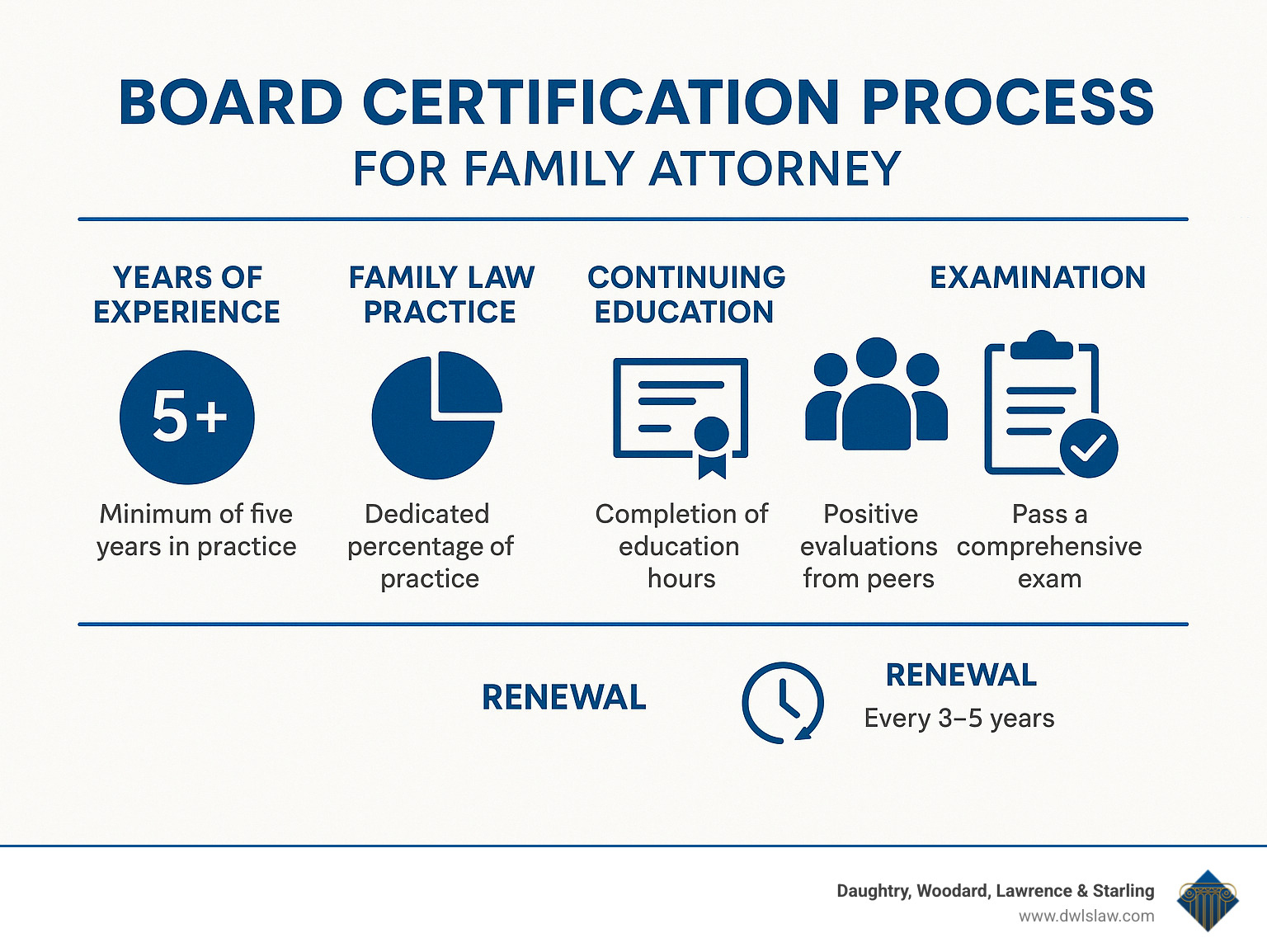
To earn this distinction, attorneys typically must:
- Show substantial hands-on experience with family law cases
- Dedicate a significant portion of their practice to family law
- Complete specialized continuing legal education
- Pass a challenging written examination
- Provide references from judges and fellow attorneys
- Maintain impeccable ethical standards
“Board Certified Family Attorney” vs. General Practitioner
The difference between a board certified family attorney and a general practitioner can be substantial when you’re facing a complex family matter.
Expertise Depth is perhaps the most important distinction. Board certified attorneys have demonstrated comprehensive knowledge of family law statutes and procedures. They’ve seen the inside of family courtrooms hundreds of times and understand the nuances that can make or break a case.
Focused Practice means certified specialists aren’t dividing their attention between criminal defense one day and real estate closings the next. They typically dedicate at least 30% of their practice to family law matters, keeping their skills sharp in this specific area.
Peer Recognition isn’t easy to earn in the legal community. For certification, attorneys must receive positive evaluations from judges and colleagues who have observed their work – people who know exactly what competent family law practice looks like.
Rigorous Examination separates the truly knowledgeable from those with surface-level understanding. The specialty exam dives deep into family law principles, procedures, and ethics – far beyond what’s covered in the general bar exam all attorneys must pass.
As one of our clients shared after her divorce, “Having an attorney who specialized in family law made all the difference. They anticipated issues before they arose and knew exactly how to steer the court system when things got complicated.”
Credentialing Organizations You Should Know
Several respected organizations provide board certification for family law attorneys. Knowing which credentials matter most in your state can help you make an informed choice.
State Bar Associations often have their own certification programs. Here in North Carolina, our NC State Bar Board of Legal Specialization certifies family law specialists after a thorough vetting process. Texas, California, and Florida also have well-established state-level certification programs with their own specific requirements.
National Board of Trial Advocacy (NBTA) offers certification in Family Trial Law with a focus on litigation skills. Their certification is recognized nationwide and requires attorneys to demonstrate substantial trial experience – a crucial factor if your case might end up in court.
American Academy of Matrimonial Lawyers (AAML) membership, while not technically a certification, is by invitation only and signifies recognition as a leading family law practitioner. Fellows of the AAML are often board certified as well, representing the upper echelon of family law expertise.
At Daughtry, Woodard, Lawrence & Starling, we’re proud to have board certified specialists who have met these rigorous standards. When your family’s future is at stake, having an attorney with verified expertise can make all the difference.
Core Requirements & Standards for Certification
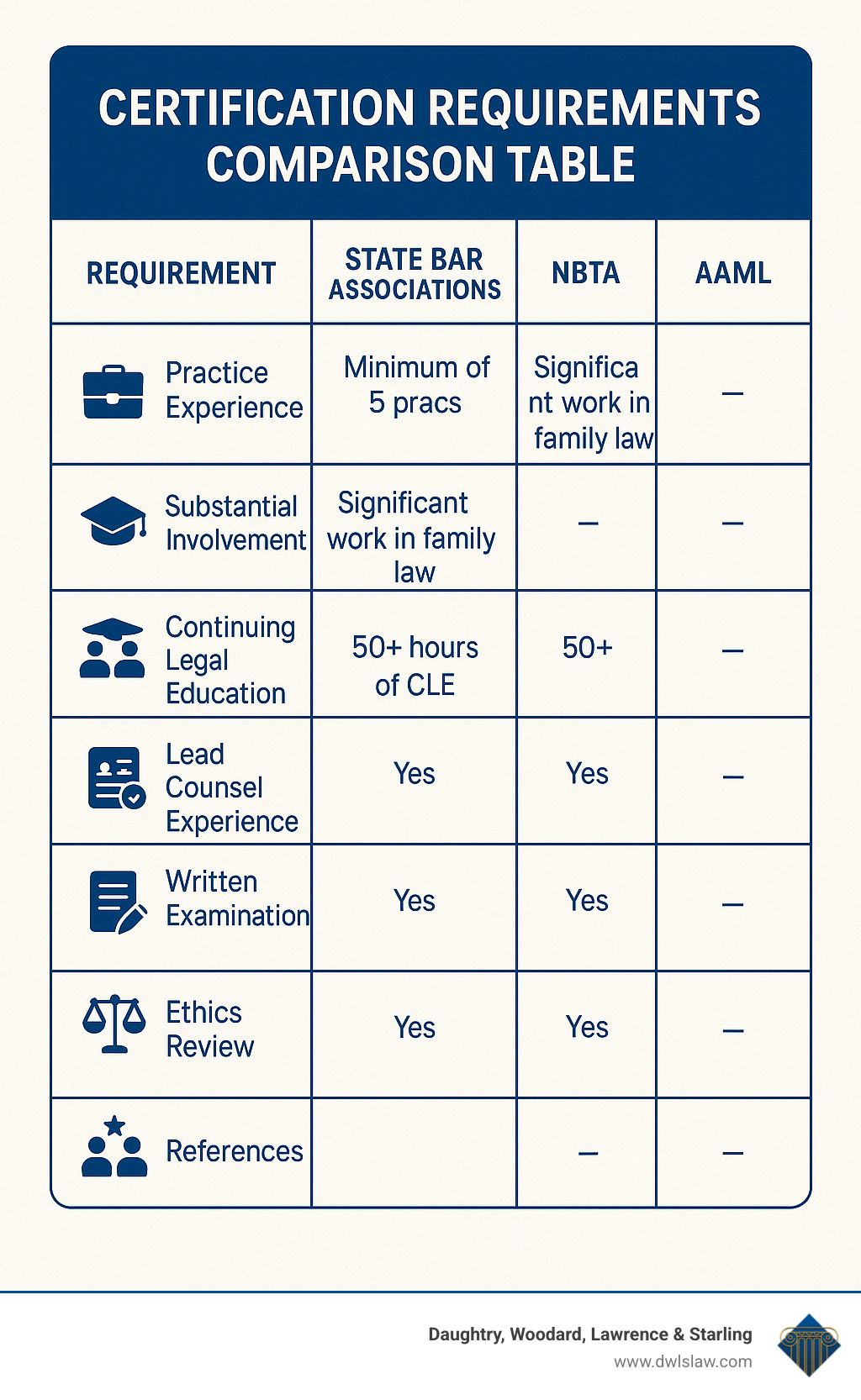
Becoming a board certified family attorney isn’t a walk in the park – and that’s by design. The certification process is intentionally challenging to ensure only truly dedicated and skilled attorneys earn this distinction. While requirements vary somewhat between states and certifying organizations, certain core standards remain consistent.
Most certification programs require at least 5 years of legal practice, with 3+ years substantially focused on family law. This ensures attorneys have steerd the real-world complexities of family cases before claiming specialist status. It’s not just about time served, though – candidates must demonstrate that a significant chunk of their practice (typically 30% or more) is dedicated to family law matters ranging from straightforward to complex.
The continuing education requirements for certification are particularly demanding. Board certified family attorneys must complete between 45-60 hours of specialized family law education, far exceeding what’s required for general practitioners. As one of our attorneys puts it, “These aren’t just check-the-box seminars – they’re intensive deep dives into evolving family law issues.”
Hands-on experience matters tremendously in the certification process. Many programs require attorneys to have served as lead counsel in numerous contested family matters. The National Board of Trial Advocacy, for instance, requires participation in at least 15 trials to verdict or judgment, totaling 30+ trial days – evidence that the attorney has truly been tested in the courtroom.
Ethical practice forms the foundation of certification. Candidates must maintain good standing with their state bar and have no significant disciplinary history. After all, family law requires not just legal knowledge but moral integrity when handling such personal matters.
At Daughtry, Woodard, Lawrence & Starling, our board certified family attorneys have not only met these rigorous standards but often exceeded them, demonstrating their unwavering commitment to excellence in family law.
Primary Keyword in the Exam Room
For lawyers seeking to become a board certified family attorney, the certification exam represents perhaps the most intimidating hurdle. This isn’t your standard multiple-choice test – it’s a comprehensive evaluation that tests not just memorization but the practical application of family law knowledge.
“I studied for months,” confesses one of our certified specialists. “The exam covers everything from basic divorce proceedings to complex interstate custody disputes and ethical dilemmas. You really need to understand the ‘why’ behind the law, not just the letter of it.”
The exam typically covers divorce and separation, child custody, support calculations, property division, domestic violence orders, adoption, jurisdictional issues, and ethical considerations in family practice. Pass rates vary, but the exams are deliberately challenging – they’re designed to separate those with deep expertise from those with merely surface knowledge.
Success requires more than memorizing statutes. It demands understanding how to apply legal principles to the messy, complicated situations that family law attorneys encounter daily. Once certified, attorneys must maintain their status through periodic renewal, ensuring board certified family attorneys stay current in their knowledge.
Continuing Education & Re-Certification
Earning board certification isn’t a lifetime achievement – it’s an ongoing commitment. Board certified family attorneys must regularly demonstrate their continued competence through education and periodic recertification.
Most certification programs require renewal every 5 years, though some states like Indiana operate on a 3-year cycle. Recertification isn’t automatic – it involves documenting continued substantial involvement in family law, completing additional specialized education, providing fresh references from judges and colleagues, maintaining ethical standards, and yes, paying those recertification fees.
“Family law evolves constantly,” notes one of our specialists. “From changing perspectives on shared parenting to the complexities of dividing digital assets and cryptocurrency in divorces – what worked five years ago might not be best practice today.”
This commitment to ongoing education ensures certified specialists stay current with evolving family law statutes, precedent-setting cases, and procedural changes. At Daughtry, Woodard, Lawrence & Starling, our attorneys accept this continuous learning process, recognizing that staying at the forefront of family law developments directly benefits our clients during life’s most challenging transitions.
More info about ongoing education
State-by-State Certification Process
The journey to becoming a board certified family attorney looks quite different depending on which state you call home. These variations reflect each state’s unique approach to ensuring families receive quality legal representation during life’s most challenging moments.
How North Carolina Does It
Here in North Carolina, where our team at Daughtry, Woodard, Lawrence & Starling practices, board certification is no small achievement. The North Carolina State Bar Board of Legal Specialization oversees a process so thorough that only 3.9% of attorneys in our state have earned this distinction.
What does it take to join this select group? First, attorneys must submit an application and pay approximately $300 to even be considered for the specialist examination. The exam itself is comprehensive, designed to separate those with casual knowledge from true family law experts.
Beyond testing, candidates must complete at least 36 hours of continuing legal education in family law, with half of those hours specifically focused on the specialty area. Peer recognition plays a crucial role too – candidates must provide references from judges and fellow attorneys who can speak to their family law competence.
The final hurdle involves demonstrating substantial involvement in family law for at least five years, showing meaningful experience across various family law matters. Once certified, our attorneys commit to renewal every five years, proving their continued dedication to family law excellence.
How Texas Does It
The Lone Star State boasts one of America’s oldest and most respected legal specialization programs. The Texas Board of Legal Specialization has certified approximately 6,900 attorneys out of 120,000 licensed lawyers – less than 6% of the state’s legal professionals.
Texas sets a clear bar: attorneys must devote at least 30% of their practice to family law for three consecutive years before even applying. They need a minimum of 5 years in legal practice, with at least 3 years focused on family law matters.
The continuing education requirement is particularly demanding, with 60 hours of family law CLE needed. Like North Carolina, Texas requires passing a challenging written examination and submitting references from judges and attorneys familiar with the applicant’s work.
Texas specialists pay an annual certification fee and must recertify every 5 years, ensuring their knowledge stays current as family law evolves.
How Indiana & Other States Differ
Indiana’s approach offers some interesting contrasts to other certification programs. Rather than annual testing, Indiana offers certification exams every other year. The state also recognizes certification through approved Independent Certifying Organizations (ICOs), creating multiple pathways to specialist status.
The financial commitment in Indiana is clearly defined: $300 application fee, $250 testing fee, $100 annual certification fee, and $300 for recertification, which comes due every 5 years.
California takes a particularly strict approach – only attorneys certified by the State Bar of California Board of Legal Specialization may call themselves Certified Family Law Specialists (CFLS). Meanwhile, Florida has established a special agreement with the National Board of Trial Advocacy, requiring Florida attorneys to complete additional CLE credits to advertise their NBTA certification.
These variations reflect each state’s unique philosophy on ensuring quality representation in family law. At Daughtry, Woodard, Lawrence & Starling, we’re intimately familiar with North Carolina’s rigorous standards and proud to have attorneys who’ve cleared these high problems to better serve families in Smithfield, Clinton, and surrounding communities.
American Board of Certification
National Board of Trial Advocacy
National Elder Law Foundation
Family Law Section, Indiana State Bar Association
Probate, Trust & Real Property Section, Indiana State Bar Association
Why Hire a Board Certified Family Attorney?
When facing a family law matter, the decision to hire a board certified family attorney can make a real difference in your case outcome. It’s not just about having a lawyer – it’s about having the right lawyer with proven expertise.

Think of board certification as a seal of quality assurance. It’s not a credential that’s simply claimed – it’s earned through demonstrable expertise and rigorous testing. These attorneys have proven their abilities both in and out of the courtroom.
Board certified family attorneys bring proven trial skills to the table. Many certification programs, especially the NBTA’s Family Trial Law certification, require substantial courtroom experience. This means your attorney has already demonstrated their ability to effectively advocate in high-pressure trial settings.
This expertise also gives them a distinct edge in negotiations. They understand the likely outcomes if a case goes to trial, which often leads to more favorable settlements without the need for lengthy court battles. As one client of our firm shared:
“Having a board certified specialist handle my divorce gave me confidence during a very uncertain time. Their expertise was evident in how they anticipated issues and steered complex property division questions.”
There’s also real comfort in knowing your attorney has met rigorous standards during what is often one of life’s most stressful experiences. While no attorney can guarantee specific results, studies suggest that specialists tend to achieve more favorable outcomes in complex cases due to their focused expertise and experience.
Tangible Benefits in Divorce & Custody Cases
The advantages of working with a board certified family attorney become particularly clear in divorce and custody cases, where emotions run high and the legal issues can be incredibly complex.
These specialists typically achieve higher settlement rates without the need for drawn-out litigation. Their reputation and demonstrated expertise often encourage opposing parties to negotiate reasonably rather than fight every issue.
Cases tend to resolve faster with certified specialists handling them. Their focused knowledge allows them to work more efficiently, potentially reducing both the time and emotional toll of family law proceedings – something every client appreciates.
In high-asset divorces, board certified family attorneys bring specialized knowledge about business valuation, retirement account division, tax implications, and other complex financial matters. This expertise proves crucial in protecting your financial future when everything is on the line.
For parents, perhaps nothing matters more than child custody matters. Certified specialists understand the nuances of “best interest” standards and know how to effectively present evidence related to parenting capacity and children’s needs in ways that truly matter to the court.
At Daughtry, Woodard, Lawrence & Starling, our family law team includes board certified specialists who bring this specialized expertise to every case, whether it involves complex property division or sensitive custody issues.
Impact on High-Stake Litigation
In particularly complex or contentious family law cases, the value of a board certified family attorney becomes even more significant.
Complex property division cases require specialized knowledge. When your divorce involves business interests, professional practices, substantial retirement assets, or international property, having someone who deals with these complicated matters regularly can make all the difference in protecting what you’ve worked for.
International custody issues present special challenges. When custody disputes cross international borders, the expertise of certified specialists in areas like the Hague Convention on International Child Abduction becomes invaluable. These aren’t matters for attorneys who only occasionally handle family law.
The trial experience of certified attorneys speaks volumes. Those certified by the National Board of Trial Advocacy have demonstrated significant courtroom experience—at least 15 trials to verdict, including a minimum of 30 trial days. This experience proves crucial when the stakes are highest.
These specialists also maintain valuable expert networks. They typically have established relationships with financial experts, forensic psychologists, and other professionals whose testimony may be critical in complex cases. These connections can be the difference between winning and losing.
As one judge commented about a board certified family attorney from our firm: “Their preparation and knowledge of both the law and the facts set them apart in the courtroom. They bring a level of expertise that clearly benefits their clients in complex matters.”
Typical Cases & Specialized Expertise
When you work with a board certified family attorney, you’re getting someone who handles a wide range of family matters with depth and precision. At Daughtry, Woodard, Lawrence & Starling, our certified specialists aren’t just familiar with family law—they live and breathe it every day.
Divorce cases form a significant portion of our practice, ranging from straightforward, uncontested separations to complex divisions involving businesses, professional practices, or substantial assets. Our attorneys understand the emotional and financial stakes involved when marriages end.
Child custody matters require both legal expertise and genuine sensitivity. Whether establishing initial arrangements, modifying existing orders when circumstances change, or handling complicated relocation cases, our board certified family attorneys keep the children’s best interests at the center of every strategy.
Financial security matters deeply in family transitions. Our team handles alimony and spousal support determinations with careful attention to factors like marriage length, earning capacity, and established standard of living. Similarly, property division requires thoughtful analysis to ensure equitable distribution of everything from retirement accounts to real estate and business interests.
Families form in many ways, and our adoption expertise covers stepparent adoptions, agency placements, and independent adoptions—including those complex cases that cross state lines. We guide families through each step with warmth and precision.
In sensitive domestic violence situations, our attorneys provide compassionate yet powerful advocacy, obtaining protective orders and addressing these issues within divorce and custody proceedings with the care they demand.
Our expertise extends to international family law matters, including cases involving the Hague Convention on International Child Abduction and cross-border custody disputes. We also establish guardianships for minor children or incapacitated adults, ensuring vulnerable individuals receive proper care and oversight.
Planning for the future? Our board certified family attorneys draft and review prenuptial and postnuptial agreements that protect assets and clarify financial responsibilities, helping couples start their marriages with clarity and confidence.
The breadth of these practice areas demonstrates why specialized knowledge matters so deeply. Family law touches the most important aspects of people’s lives—their children, homes, financial security, and personal safety.
7 Things You Should Know About Child Custody
Board Certified Family Attorney in the Courtroom
A board certified family attorney brings something special to the courtroom environment. When your case needs litigation, this specialized training and experience translates to more effective advocacy.
In trial settings, you’ll notice the difference. Our certified specialists demonstrate superior trial advocacy skills that come from the substantial courtroom experience required for certification. This experience builds not just technical skill but also strategic courtroom instincts that can make all the difference in family matters.
“I’ve seen how judges respond differently when they know they’re dealing with a board certified attorney,” shares one of our clients. “There’s an immediate level of credibility that comes with that certification.”
The procedural expertise our specialists bring means they understand family court procedures inside and out, allowing them to steer evidentiary issues and procedural challenges with confidence and efficiency. Their comprehensive case preparation includes effective use of expert witnesses and compelling presentation of evidence.
At Daughtry, Woodard, Lawrence & Starling, our board certified family attorneys have earned their reputations for effective courtroom advocacy by combining deep legal knowledge with persuasive presentation skills—a combination that consistently achieves favorable outcomes for our clients.
Beyond the Courtroom: Mediation & Collaborative Law
Not every family matter needs to be decided by a judge. Many of our board certified family attorneys are also skilled in alternative dispute resolution methods that can resolve family disputes more efficiently and with less emotional strain than traditional litigation.
Settlement agreements are an art form in themselves. Our certified specialists excel at drafting comprehensive agreements that address all relevant issues while protecting our clients’ interests. These agreements create roadmaps for moving forward that help prevent future conflicts.
When retirement assets need division in divorce, Qualified Domestic Relations Orders (QDROs) become necessary. These specialized orders have technical requirements that our certified specialists understand thoroughly, ensuring proper division of these important assets.
Planning to marry? Our board certified family attorneys bring valuable expertise to drafting and reviewing prenuptial agreements. We ensure these documents meet all statutory requirements for enforceability while addressing the unique concerns of each couple.
As family structures evolve, our certified specialists stay current with legal issues related to assisted reproductive technology, same-sex marriage and divorce, and various co-parenting arrangements. Modern family formation sometimes requires creative legal solutions, and we’re ready to provide them.
Many clients at Daughtry, Woodard, Lawrence & Starling appreciate having access to these alternative approaches while knowing they have the support of a board certified family attorney who can shift to effective litigation if necessary. This flexibility gives our clients options while ensuring they always have powerful advocacy in their corner.
How to Verify & Choose the Right Specialist
Finding the perfect board certified family attorney is a bit like dating – you need to verify credentials and make sure there’s a good fit for your specific situation. But don’t worry, we’ve got you covered with some practical advice.
State bar associations are your first stop for verification. Most maintain searchable online directories where you can quickly confirm an attorney’s certification status. In North Carolina, you can visit nclawspecialists.gov to search for certified specialists by practice area. It takes just a few minutes but provides valuable peace of mind.
If your attorney claims national certification, organizations like the National Board of Trial Advocacy (NBTA) offer online verification tools as well. A quick search can confirm whether their credentials are current and legitimate.
“When I was looking for a family attorney, checking credentials was my first step,” shares one of our clients. “It helped me narrow down my options to professionals who had proven their expertise.”
Peer reviews and ratings can provide additional insight beyond the certification itself. These reviews often reveal how an attorney works with clients and their reputation among other legal professionals.
Most family law attorneys, including our team at Daughtry, Woodard, Lawrence & Starling, offer initial consultations. Use this opportunity wisely! Ask about their certification, their experience with cases similar to yours, and their general approach to family law matters. This conversation will tell you a lot about whether you’ll work well together.
Fee transparency is also crucial. While board certified family attorneys may charge higher hourly rates, their efficiency and expertise can sometimes result in lower overall costs. Don’t be shy about discussing fees upfront – a good attorney will be transparent about their billing structure.
More info about Divorce Lawyer services
Quick Verification Checklist
Before you commit to working with a board certified family attorney, run through this simple verification checklist:
First, confirm their license status – are they currently licensed and in good standing with the state bar? This is fundamental and non-negotiable.
Next, check their certification date. When were they initially certified, and more importantly, is their certification current? Certification requires renewal, and an expired certification is a red flag.
Ask about their continuing legal education (CLE). Board certified specialists must complete substantial ongoing education to maintain their status. A committed specialist should be able to tell you about recent CLE activities specifically in family law.
Take a moment to check their disciplinary history. Most state bar websites allow you to verify whether an attorney has faced any disciplinary action. This information is public for a reason – use it!
Finally, verify which organization granted their certification and whether it’s recognized in your state. Not all certifications carry the same weight in every jurisdiction.
Red Flags & Questions to Ask
When meeting with a potential board certified family attorney, trust your instincts and be alert for warning signs.

Be cautious if an attorney can’t clearly explain their certification process or seems vague about their credentials. Similarly, if they haven’t renewed their certification recently, that could indicate they’re not maintaining their specialized status.
Despite certification, some attorneys have minimal trial experience. If your case might go to court, this could be problematic. A good attorney will be transparent about their courtroom experience.
Pay attention to communication from the very beginning. If they’re slow to respond during the courting phase, imagine how frustrating it might be when you’re in the middle of a case! Similarly, if they make promises that sound too good to be true about specific outcomes, they probably are.
Smart questions to ask during your consultation include:
“When was your certification last renewed?” This reveals whether they’re keeping their specialized status current.
“What percentage of your practice focuses on family law?” For a specialist, this number should be substantial – typically 30% or more.
“How many cases like mine have you handled recently?” Experience with similar situations is invaluable.
“What’s your philosophy on settlement versus litigation?” This reveals their approach and whether it aligns with your goals.
Also ask about communication expectations, who else might work on your case, their fee structure, and their honest assessment of potential outcomes for your situation.
At Daughtry, Woodard, Lawrence & Starling, we welcome these questions. We believe in building relationships based on trust and transparency from day one. Finding the right board certified family attorney takes a little homework, but when your family’s future is at stake, it’s time well spent.
Continuing Obligations: Education, Ethics & Renewal
Earning board certification isn’t the finish line—it’s more like joining an elite club with ongoing membership requirements. For a board certified family attorney, the credential represents a continuing journey of growth and excellence.
Think of certification as a promise to clients and colleagues that you’re committed to staying at the top of your game. This commitment comes with specific responsibilities that certified attorneys must fulfill to maintain their special status.
The continuing education requirements are substantial—typically 45-60 hours of family law-specific CLE during each certification period. That’s significantly more than what’s required for regular attorney licensure. These educational hours ensure specialists stay current with evolving case law, statutory changes, and emerging issues in family practice.
“The extra CLE hours aren’t just a box to check,” explains one of our certified attorneys at Daughtry, Woodard, Lawrence & Starling. “They’re genuinely valuable for keeping our knowledge fresh and finding new approaches to help our clients.”
When renewal time comes around (typically every five years), board certified family attorneys must again demonstrate their worthiness through peer endorsements. Judges and fellow attorneys who have observed their work must vouch for their continued competence and ethical practice—a process that keeps specialists accountable to the highest standards.
Ethics remains paramount throughout a specialist’s career. Certification boards conduct ethics audits during the renewal process, reviewing disciplinary records and requiring attestations of ethical practice. Any serious ethical lapses can result in loss of certification, regardless of technical knowledge or courtroom skill.
Some jurisdictions even require specialists to pass additional examinations as part of recertification, ensuring their knowledge remains current and comprehensive.
Perhaps most importantly, specialists understand that their credential isn’t permanent. If they fail to meet renewal requirements or choose not to recertify, they lose the right to identify as a board certified family attorney. This non-permanence of the credential helps maintain its value and meaning within the legal community.
At Daughtry, Woodard, Lawrence & Starling, our certified specialists accept these continuing obligations as part of their professional identity. The extra work isn’t just about keeping a credential—it’s about delivering the highest level of service to clients facing life-changing family law matters.
Latest research on specialization
Staying Current in a Changing Family Law Landscape
Family law never stands still. It evolves constantly, reflecting changes in society, technology, and our understanding of family structures. For board certified family attorneys, staying current isn’t optional—it’s essential.
State legislatures regularly update domestic statutes related to custody, support, and property division. What was standard practice five years ago might now be outdated. The rapid evolution of LGBTQ+ rights has transformed many aspects of family law, creating new precedents and considerations for marriage, divorce, and parenting.
The digital revolution has introduced novel questions about dividing cryptocurrency, online businesses, and digital property in divorce cases. Who gets the Bitcoin? How do you value an Instagram influencer account? These weren’t questions family lawyers faced a decade ago.
The COVID-19 pandemic accelerated the adoption of virtual hearings, requiring attorneys to develop new advocacy skills for effective representation in remote settings. Persuading a judge through a screen requires different techniques than in-person advocacy.
As families become increasingly global, international treaties and foreign law increasingly impact family practice. A board certified family attorney might need to steer the Hague Convention on International Child Abduction or understand how a foreign marriage contract affects property rights in a North Carolina divorce.
“Family law practice in 2023 looks very different than it did when I first became certified,” notes one of our specialists at Daughtry, Woodard, Lawrence & Starling. “That’s why continuing education isn’t just a requirement—it’s essential for effective representation.”
Our commitment to ongoing learning ensures that our board certified family attorneys remain at the forefront of these evolving areas. When you work with a certified specialist at our firm, you benefit from representation that’s not just experienced but also current with the latest developments that might affect your case.
Frequently Asked Questions about Board Certification
What percentage of attorneys are board certified in family law?
If you’re looking for a board certified family attorney, you’re seeking someone in a rather exclusive club. The numbers tell an interesting story about just how selective this credential is.
In North Carolina, where our firm practices, only 3.9% of all attorneys have achieved board certification in any specialty area. That’s less than 1 in 25 lawyers who have demonstrated this level of expertise and commitment.
Texas, known for having one of the oldest certification programs, reports that fewer than 6% of their attorneys (approximately 6,900 out of 120,000 licensed lawyers) hold board certification.
These small percentages highlight something important: board certification isn’t just another credential that most attorneys pick up along the way. It truly represents a commitment to excellence that sets these attorneys apart.
How long does the certification process take?
Becoming a board certified family attorney isn’t a quick process—and that’s by design. The journey typically takes 6-12 months from submitting an application to receiving final approval.
But that timeline only tells part of the story. Before an attorney can even apply, they must build a foundation of experience and knowledge. Most certification programs require at least 5 years of practice with substantial focus on family law before an attorney can even begin the certification process.
The examination itself is a significant milestone, offered just once per year in most states. Some states, like Indiana, only offer the exam every other year, which can extend the timeline even further.
As one of our attorneys describes it, “Board certification isn’t a sprint—it’s more like training for a marathon while also handling a full caseload.”
Does board certification guarantee a better case outcome?
We believe in straight talk with our clients, and the honest answer is no—no ethical attorney can guarantee specific outcomes in any legal matter, regardless of their credentials. Family law cases involve too many variables, including the unique facts of each situation, the perspectives of judges, and the actions of opposing parties.
That said, the specialized knowledge and extensive experience that board certified family attorneys bring to the table can make a meaningful difference. Their deep understanding of family law principles, familiarity with local courts and judges, and refined skills in negotiation and litigation often contribute to more efficient case management and potentially better results.
At Daughtry, Woodard, Lawrence & Starling, we see board certification as a reflection of our commitment to excellence in family law practice. But we also recognize that each family’s situation is unique. Even with certified specialists, what ultimately matters most is applying that expertise to your specific circumstances with care and attention.
The value of certification often becomes most apparent in complex cases—those involving substantial assets, complicated custody arrangements, or unusual legal questions. In these situations, the specialized knowledge of a board certified family attorney can be particularly beneficial in navigating challenging legal waters.
More info about Divorce Lawyer services
Conclusion
Choosing the right attorney for your family law matter isn’t just an important decision—it’s one that can shape your future and that of your loved ones. A board certified family attorney brings something special to the table: deep expertise, proven experience, and credentials that truly mean something when the stakes are high.
Throughout our journey together in this guide, we’ve unpacked what makes these specialists different. We’ve seen the rigorous hoops they must jump through—from passing specialized exams to gathering peer recommendations. We’ve explored how North Carolina’s certification program maintains particularly high standards, ensuring only the most dedicated attorneys earn this distinction.
When you’re dealing with something as personal as divorce or child custody, expertise matters. The specialized knowledge a board certified attorney brings often translates into more efficient case management, better-crafted arguments, and a deeper understanding of how to steer family court successfully.
At Daughtry, Woodard, Lawrence & Starling, we take pride in our board certified family attorneys who serve families throughout Smithfield, Clinton, Sampson County, and across North Carolina. We understand that behind every case file is a real family facing real challenges. Your concerns about your children, your financial security, and your future aren’t just legal issues to us—they’re deeply personal matters that deserve compassionate, expert handling.
Family law isn’t just about knowing statutes and precedents (though that’s certainly important). It’s about understanding the human element—the fears, hopes, and dreams that bring clients through our doors. Our certified specialists combine their legal expertise with a genuine commitment to your wellbeing, working to achieve outcomes that help you move forward with confidence.
If you’re standing at the crossroads of a family law matter, we invite you to experience the difference that board certified expertise can make. The peace of mind that comes from knowing your case is in capable, specialized hands is invaluable during uncertain times.
More info about Divorce Lawyer services
