

Why Business Law Attorneys Are Essential for Your Success
Business law attorneys provide crucial legal guidance for companies of all sizes, from startup formation to complex mergers and acquisitions. These specialized lawyers help entrepreneurs steer corporate structures, draft contracts, ensure regulatory compliance, and protect business assets through strategic legal planning.
Key services business law attorneys provide:
- Entity formation – LLCs, corporations, partnerships, and professional entities
- Contract drafting and review – Employment agreements, vendor contracts, and licensing deals
- Mergers and acquisitions – Due diligence, valuations, and purchase agreements
- Compliance and governance – Corporate maintenance, regulatory filings, and risk management
- Dispute resolution – Commercial litigation, mediation, and arbitration
- Intellectual property protection – Trademarks, copyrights, and trade secrets
- Commercial real estate – Leasing, financing, and property transactions
The legal landscape for businesses has become increasingly complex. As one experienced attorney noted, “In today’s business environment, where a single mouse-click can instantly transfer millions of dollars… you and your fellow business owners might feel understandably overwhelmed by the sheer magnitude and speed of the change in virtually every aspect of doing business in the 21st century.”
The benefits of working with business law attorneys are clear:
- Limited liability protection through proper corporate structures
- Tax advantages – corporations pay approximately 16% on the first $500,000 of income
- Risk mitigation through comprehensive legal planning
- Professional credibility with properly maintained corporate records
I’m Kelly K. Daughtry, and with over five decades of experience at Daughtry, Woodard, Lawrence & Starling, I’ve helped countless North Carolina businesses steer complex legal challenges with business law attorneys who understand both the legal intricacies and practical realities of running a company.
Business Law 101: Foundations Every Owner Should Know
Think of business law as the foundation of your house – you might not see it every day, but everything else depends on it being solid. Understanding these fundamentals can save you serious headaches (and money) down the road.
At its heart, business law covers all the rules governing how companies operate. This includes everything from setting up your business structure to handling customer disputes. While some businesses reference frameworks like the Ontario Business Corporations Act, here in North Carolina we follow our own state corporate laws.
Proper business structuring creates what we call a limited liability shield. When you incorporate or form an LLC, you’re essentially building a legal wall between your business and your personal assets. If your company faces financial trouble, creditors generally can’t come after your house, car, or personal savings.
But this protection isn’t automatic. You need proper formation and ongoing compliance with corporate rules to keep that shield strong.
The tax benefits are compelling too. Corporations typically pay around 16% on the first $500,000 of active business income, while personal tax rates can climb past 50%. That difference can save you tens of thousands of dollars every year.
These benefits come with responsibilities. Corporate maintenance isn’t just a good idea – it’s legally required. The minimum requirements include holding annual shareholder meetings to review finances, elect directors, and appoint auditors. Skip these steps, and you risk losing that valuable liability protection.
Scientific research on governance rules shows that companies with strong legal frameworks significantly outperform those that wing it.
Key Areas of Modern Business Law
Modern business law attorneys steer an increasingly complex world that touches every part of your business.
Contracts are the backbone of almost every business relationship. Whether you’re hiring your first employee, working with suppliers, or licensing technology, contracts spell out who does what and what happens if things go sideways.
Intellectual property protection has become crucial in today’s economy. Your business name, logo, unique processes, and creative work are valuable assets that need legal protection.
Employment law affects every business with employees. Recent federal changes raised overtime salary thresholds to $844 per week ($43,888 annually), affecting who qualifies for executive, administrative, and professional exemptions.
Real estate considerations impact most businesses, whether you’re buying property, signing leases, or dealing with zoning issues.
Business financing brings securities laws into play – and yes, this applies to small companies too. Many business owners are surprised to learn that raising money from investors triggers federal and state regulations.
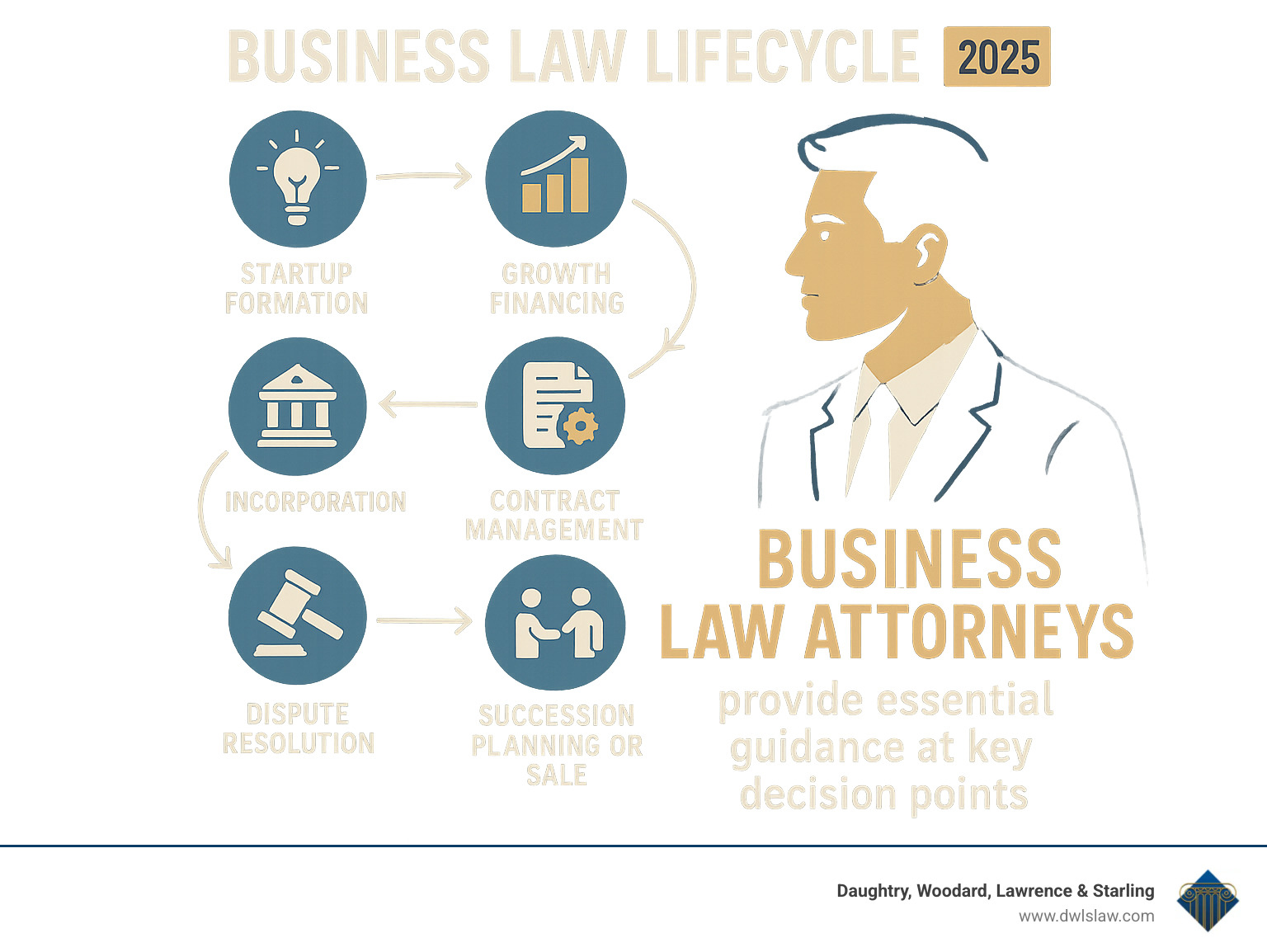
When to Call Business Law Attorneys
Timing is everything in business law. While it’s tempting to handle legal matters yourself initially, some situations absolutely require professional help.
Start-ups get huge value from early legal involvement. Choosing the wrong business structure is expensive and painful to fix later.
Growth financing triggers securities laws and requires careful planning to protect both you and your investors.
Mergers and acquisitions involve complex due diligence, valuation questions, and risk sharing between buyers and sellers.
Business disputes can escalate quickly and threaten your company’s survival. Getting legal help early often resolves conflicts through negotiation or mediation.
Succession planning needs advance preparation to minimize taxes and ensure smooth transitions.
Business Law Attorneys: Core Services & Value
The value business law attorneys provide extends far beyond simple document preparation. We serve as strategic advisors who help you understand the legal implications of business decisions before you make them.
Consider the difference between asset purchases and share purchases in business transactions. In an asset purchase, you buy specific business assets and assume only designated liabilities. In a share purchase, you acquire the entire legal entity, including all its assets, liabilities, and potential unknown risks.
Our core services encompass the full business lifecycle. We handle incorporations and entity formations, draft shareholder agreements and partnership pacts, manage mergers and acquisitions, and provide intellectual property protection.
Compliance audits help identify potential legal issues before they become problems. Succession planning ensures business continuity and minimizes tax consequences when ownership transfers occur.
More info about business formation
Formations & Incorporations – How Lawyers Help
Choosing the right business structure is one of the most important decisions you’ll make as an entrepreneur. The decision impacts your tax obligations, personal liability exposure, operational flexibility, and future growth options.
Limited Liability Companies (LLCs) offer operational flexibility with pass-through taxation. They’re ideal for businesses with multiple owners who want to avoid corporate formalities while maintaining liability protection.
Corporations provide the strongest liability protection and offer unique tax planning opportunities. C-corporations face double taxation but allow income splitting. S-corporations eliminate double taxation while maintaining corporate liability protection.
Professional entities serve licensed professionals like doctors, lawyers, and accountants. These structures provide liability protection while complying with professional licensing requirements.
The formation process involves more than just filing paperwork. We help clients choose appropriate business names, draft operating agreements or bylaws, and establish proper record-keeping systems.
Minute books and corporate records aren’t just paperwork – they’re legal requirements that protect your liability shield. Courts can “pierce the corporate veil” and hold owners personally liable if corporate formalities aren’t maintained.
Tax planning considerations are crucial during formation. The choice between different entity types can save thousands of dollars annually in taxes.
More info about How to Start an LLC
Drafting Shareholder & Partnership Agreements
Partnership and shareholder agreements are among the most important documents your business will ever have. Every business with multiple owners needs these agreements.
Without written agreements, state default laws govern your business relationships. These generic rules rarely match your specific needs and can create problems when disputes arise. The single most important clause is the dispute resolution and exit provision.
Voting rights provisions determine how important decisions get made. Exit clauses provide mechanisms for partners to leave the business without destroying it. Dispute resolution mechanisms can save enormous amounts of time and money.
We’ve seen too many successful businesses destroyed by partnership disputes that could have been avoided with proper agreements.
More info about partnership pitfalls
Mergers, Acquisitions & Business Sales
Mergers and acquisitions represent some of the most complex transactions in business law. Whether you’re buying or selling a business, the legal structure of the deal can dramatically impact the financial outcome and future risks.
Due diligence is the process of investigating a business before completing a transaction. This involves reviewing corporate contracts, conducting public record searches, examining litigation history, and verifying tax compliance.
Valuations determine the fair price for a business, but legal factors significantly impact value. Outstanding litigation or regulatory compliance issues can reduce a company’s worth.
Purchase agreements allocate risks between buyers and sellers. These agreements address countless “what if” scenarios and can run hundreds of pages.
Commercial Real Estate & Leasing Issues
Commercial real estate transactions involve unique legal considerations that differ significantly from residential deals.
Commercial leases are complex documents that can span decades and involve millions of dollars. Key issues include rent escalation clauses, maintenance responsibilities, assignment rights, and termination provisions.
Financing commercial real estate often involves complex loan structures, personal guarantees, and security agreements.
Landlord-tenant disputes in commercial settings involve different laws and procedures than residential matters.
Scientific research on leasing statutes provides frameworks for understanding tenant rights and landlord obligations.
Dispute Resolution & Risk Management
Business disputes are unfortunately common, but how you handle them can determine whether they become minor inconveniences or company-threatening crises.
Litigation should typically be a last resort, but sometimes it’s necessary to protect your rights. Mediation offers a less adversarial approach where a neutral third party helps facilitate negotiations. Arbitration provides binding dispute resolution outside the court system.
Risk management involves identifying potential legal problems before they occur. Regular contract reviews, compliance audits, and legal check-ups can prevent many disputes from arising.
More info about business litigation

How to Choose the Right Business Law Attorneys
Finding the right business law attorneys feels a lot like choosing a business partner – because in many ways, that’s exactly what you’re doing. Your attorney will help shape major decisions that affect your company’s future, so this choice deserves careful consideration.
Experience in business law makes all the difference. Business law involves specialized knowledge about securities regulations, tax implications, and corporate governance that takes years to master.
Industry knowledge can be incredibly valuable. An attorney who understands your specific business sector knows the regulatory landscape, common contract terms, and industry-specific risks.
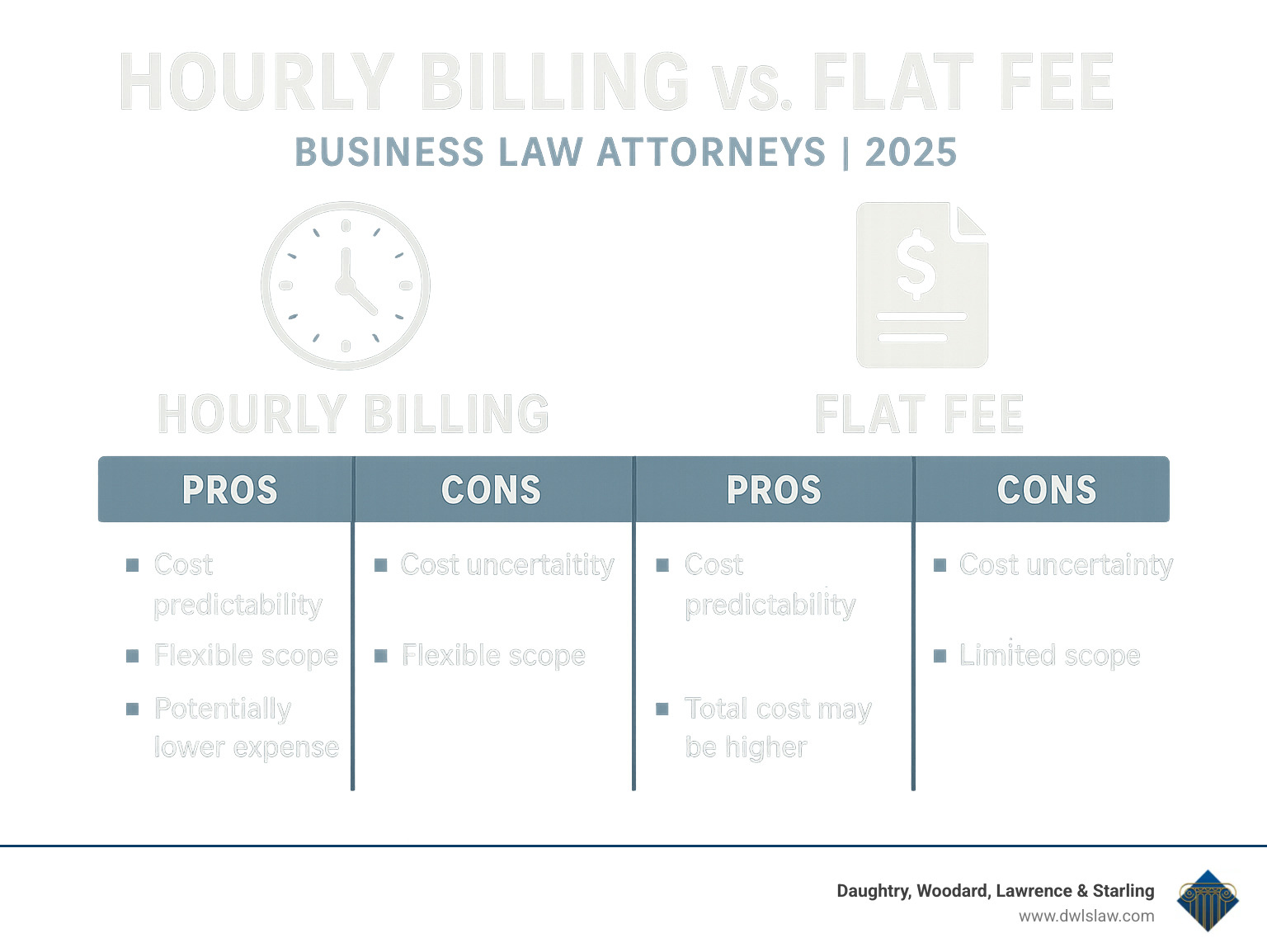
Fee structures vary widely in business law. Some attorneys charge by the hour, others offer flat fees for routine services. Many practices use hybrid approaches, combining flat fees for predictable work with hourly billing for complex matters.
The key is finding an attorney who’s transparent about costs upfront. Nobody likes billing surprises, especially when you’re trying to manage business cash flow.
Communication style matters more than you might think. Find someone whose approach matches your business pace and preferences.
Collaborative attitude is essential because business law doesn’t exist in a vacuum. Your attorney needs to work well with your accountant, insurance agent, and other advisors.
At Daughtry, Woodard, Lawrence & Starling, we provide bilingual support to serve our diverse business community in Smithfield, Clinton, and Sampson County.
Questions to Ask Prospective Business Law Attorneys
The right questions can reveal a lot about whether business law attorneys are a good fit for your needs. Don’t be shy about interviewing potential attorneys.
Ask about their specific credentials and experience. Board certifications and professional ratings indicate peer recognition for competence and ethics. Also ask about hands-on experience with businesses like yours.
Understand their communication approach. How quickly do they typically respond to calls and emails? Will you work directly with the attorney or mainly with support staff?
Get realistic timelines for your type of work. Understanding typical timeframes helps you plan business decisions and avoid unrealistic expectations.
Evaluate their technology comfort level. Modern businesses involve software licensing agreements, e-commerce terms, and digital contracts. Your attorney should understand these technologies and their legal implications.
Collaborating with Accountants & Other Advisors
The magic happens when your business law attorneys work seamlessly with your other professional advisors. Think of it as assembling your business dream team.
Tax planning decisions require both legal and accounting expertise. Your attorney understands the legal implications of different business structures, while your accountant can model the tax consequences.
Corporate governance needs ongoing attention from both professions. Your attorney ensures you’re meeting legal requirements, while your accountant helps maintain proper financial records.
We regularly collaborate with accounting firms, insurance professionals, and other advisors to provide comprehensive business guidance.
More info about employment contracts
Key Trends & Legal Developments in 2024-25
The business law landscape continues evolving rapidly, and staying current with legal developments is crucial for business success. Several key trends are shaping how business law attorneys serve their clients.
Individual with Significant Control (ISC) registers are becoming more common as governments seek transparency in business ownership. These requirements affect privacy and compliance obligations for many businesses.
Environmental, Social, and Governance (ESG) reporting is expanding beyond large public companies to affect smaller businesses, especially those in supply chains of major corporations. These requirements create new compliance obligations and business opportunities.
Digital contracts and electronic signatures have become standard business practices, but they require careful attention to legal requirements. Not all contracts can be signed electronically, and some industries have specific requirements for digital transactions.
Federal overtime rule changes took effect in 2024, raising salary thresholds for overtime exemptions. The new threshold of $844 per week ($43,888 annually) affects many businesses’ compensation structures and requires review of employee classifications.
Cross-border trade regulations continue evolving, affecting businesses that import materials, export products, or have international operations. Understanding these requirements is crucial for avoiding compliance problems.

Why Tech-Ready Business Law Attorneys Matter
Modern businesses operate in increasingly digital environments, and your legal counsel must understand these technologies to provide effective advice.
E-signatures are legally valid for most business contracts, but specific requirements must be met. Your attorney should understand the Electronic Signatures in Global and National Commerce Act (ESIGN) and state equivalents to ensure your digital contracts are enforceable.
Software-as-a-Service (SaaS) agreements have unique legal considerations including data ownership, service level guarantees, and termination procedures. These contracts often involve ongoing relationships rather than one-time transactions, requiring different legal approaches.
Data privacy regulations like GDPR and state privacy laws create compliance obligations for businesses that collect customer information. Your attorney should understand these requirements and help you develop appropriate privacy policies and data handling procedures.
Cyber risk management involves both insurance considerations and legal compliance requirements. Businesses need incident response plans, vendor agreements that address cybersecurity, and insurance coverage that matches their actual risks.
We stay current with technological developments to provide relevant advice for modern businesses. Whether you’re negotiating cloud computing agreements or developing mobile apps, legal guidance should improve rather than hinder your business objectives.
Frequently Asked Questions about Business Law Attorneys
When you’re considering working with business law attorneys, you probably have questions about what they do and how they can help your business. Let me address the most common concerns I hear from clients.
What’s the difference between an asset purchase and a share purchase?
This is one of the most important distinctions in business sales, and getting it wrong can cost you dearly. Think of it this way: buying assets is like cherry-picking what you want from a business, while buying shares means you’re taking the whole package – good and bad.
In an asset purchase, you’re essentially shopping for specific pieces of a business. You might buy the equipment, customer lists, and inventory, but leave behind the debts, pending lawsuits, or tax problems. This gives you much more control over what you’re getting into.
A share purchase is more like buying a house – you get everything that comes with it, including any problems hiding in the basement. You’re purchasing the entire legal entity, which means all the contracts stay in place and business operations continue smoothly. The downside? You also inherit every liability, even ones you don’t know about yet.
The choice between these approaches depends on your situation. Each deal is unique, and that’s why business law attorneys spend so much time analyzing these decisions with clients.
Do I really need annual corporate minutes if I’m a small corporation?
I get this question all the time, usually from busy business owners who think corporate minutes are just bureaucratic paperwork. Here’s the truth: yes, you absolutely need them, and here’s why it matters more than you might think.
Corporate minutes are like your business’s medical records – they prove you’re treating your corporation as a separate legal entity. Without them, courts can decide that your business is really just an extension of you personally. When that happens, they can “pierce the corporate veil” and hold you personally responsible for business debts.
Think of corporate minutes as insurance for your limited liability protection. You’re not just checking a box – you’re creating a legal shield that protects your house, your savings, and your family’s financial security.
The good news is that maintaining corporate minutes doesn’t have to be complicated. At minimum, you need annual meetings where shareholders review financial statements, elect directors, and handle other required business. If you don’t want to hold formal meetings, you can use written resolutions that accomplish the same thing.
How much do business law attorneys charge, and can I get a flat fee?
Money talk can be uncomfortable, but I believe in being upfront about how legal fees work. Business law attorneys use different fee structures depending on what you need.
Hourly billing is common for complex work where it’s hard to predict how much time something will take. Business litigation or complicated mergers often require this approach.
Flat fees work great for routine services like simple incorporations, basic contract reviews, or standard legal documents. When we know exactly what’s involved, we can give you a fixed price upfront.
Many attorneys offer hybrid arrangements that combine both approaches. You might pay a flat fee for the basic work, then hourly rates if the matter becomes more complex.
Some businesses benefit from monthly retainer arrangements where you pay a set amount each month for ongoing legal support.
The most important thing is getting a clear, written fee agreement before any work begins. Don’t let cost concerns stop you from getting legal help when you need it – the price of fixing legal problems is almost always much higher than preventing them.

Conclusion
Running a successful business today requires more than just a great product or service – it requires smart legal planning from the very beginning. Business law attorneys serve as your strategic partners, helping you make informed decisions that protect your assets, minimize taxes, and position your company for long-term growth.
The value of experienced legal counsel extends far beyond crisis management. When you work with skilled business law attorneys, you gain access to strategic counsel that helps you anticipate challenges before they become problems. This proactive approach is always more cost-effective than scrambling to fix issues after they arise.
Limited liability protection doesn’t happen automatically just because you file incorporation papers. It requires ongoing attention to corporate formalities, proper documentation, and compliance with legal requirements. Without this foundation, your personal assets remain at risk.
Tax efficiency represents one of the most immediate benefits of proper legal structuring. The difference between paying personal tax rates that can exceed 50% versus corporate rates around 16% on your first $500,000 of income can save you tens of thousands of dollars every year.
At Daughtry, Woodard, Lawrence & Starling, we’ve watched businesses transform over our five decades of practice. We’ve seen scrappy startups become industry leaders, family businesses successfully transition to the next generation, and entrepreneurs achieve financial independence through smart legal planning.
Our approach combines deep legal expertise with practical business sense. We understand that legal advice is only valuable if it helps you achieve your business goals. Whether you need bilingual support for diverse stakeholders or board-certified specialists for complex transactions, we tailor our services to your specific needs.
The legal landscape will continue evolving, with new regulations, tax changes, and business challenges emerging regularly. Having trusted legal counsel means you don’t have to steer these changes alone.
Don’t wait for legal problems to find you. The most successful business owners we serve are those who invest in legal planning early and maintain ongoing relationships with their attorneys. This approach prevents small issues from becoming major crises and ensures you’re always positioned to take advantage of new opportunities.
Your business deserves the same level of professional legal support that larger companies take for granted. Whether you’re in Smithfield, Clinton, or anywhere in Sampson County, we’re here to help you build the legal foundation your business needs to thrive.
More info about Addressing a Wide Range of Business Law Needs
Frequently Asked Questions
Why should I hire business law attorneys for my startup?
Business law attorneys help startups choose the right structure, maintain liability protection, and ensure compliance with state and federal laws.
How much do business law attorneys charge?
Fees vary: hourly rates for complex cases, flat fees for standard services, or hybrid arrangements for ongoing legal support.
What’s the difference between an asset purchase and a share purchase?
Business law attorneys explain that asset purchases acquire selected business assets, while share purchases take over the entire legal entity, including liabilities.
Do I need annual corporate minutes?
Yes. Business law attorneys stress that maintaining corporate minutes protects your limited liability and ensures compliance with corporate rules.
How can business law attorneys help with mergers and acquisitions?
They perform due diligence, draft purchase agreements, manage valuations, and allocate risks between buyers and sellers.


