

Protecting Yourself Through Family Law Restraining Orders
Restraining order family law provisions exist to provide legal protection from abuse, harassment, or threats from family members or intimate partners. Here’s what you need to know:
| Quick Facts: Family Law Restraining Orders |
|---|
| Purpose: Legally prevents an individual from contacting, approaching, or harming you or your children |
| Who Can Apply: Spouses, former partners, relatives, or those who share children |
| Duration: Emergency (5 days), Temporary (15-21 days), or Permanent (up to 5 years) |
| Protection Includes: No contact, stay-away distances, move-out orders, child custody, and property protection |
| Violations: Criminal offense that can result in arrest, fines, and jail time |
When your safety or your children’s wellbeing is threatened, a family law restraining order provides crucial legal protection. These court orders are designed to prevent harassment, abuse, or threats from someone with whom you have a close relationship. Studies show that restraining orders are violated in approximately 40% of cases, making it essential to understand both the protections they provide and their limitations.
Unlike criminal protective orders issued through law enforcement, family law restraining orders are obtained through family court and can include additional provisions related to child custody, support, and property protection. This makes them particularly valuable during divorce or separation when tensions are high and safety concerns may arise.
I’m Kelly K. Daughtry, a family law attorney at Daughtry, Woodard, Lawrence & Starling with extensive experience helping clients steer the complexities of restraining order family law cases in North Carolina, ensuring they receive the protection they need during difficult family transitions.
Restraining order family law terms to remember:
– attorneys in johnston county nc
– family attorney nc
– family law attorneys in smithfield nc
Understanding “Restraining Order Family Law”: What It Is & Why It Matters
When your safety feels threatened by someone close to you, restraining order family law provides a vital lifeline. These orders aren’t just pieces of paper—they’re powerful legal shields designed to keep you and your loved ones safe from harm, harassment, or threatening behavior from family members or intimate partners.
Unlike criminal protective orders that require police involvement from the start, family law restraining orders work through the family court system. This civil approach makes them more accessible when you’re facing danger from someone you once trusted.
The statistics tell a sobering story about why these protections matter. About 1 in 4 women and 1 in 7 men in the United States have experienced severe physical violence from an intimate partner during their lifetime. Here in North Carolina, our courts process thousands of protective orders annually, with many arising directly from family disputes.
The good news? Research shows these orders work. About 68% of women who obtained restraining orders against abusive partners reported feeling safer afterward, and 85% said the abuse either stopped completely or decreased significantly. However, we can’t ignore that these orders are violated in about 40% of cases—a stark reminder that while legal protection is crucial, comprehensive safety planning should go hand-in-hand with your court order.
Key Types of Restraining Orders in Family Matters
North Carolina’s family court system offers several protective options depending on your specific situation:
Domestic Violence Restraining Orders (DVROs) provide protection from current or former spouses, intimate partners, or family members. In our state, these are commonly called 50B orders, named after the North Carolina statute that governs them.
Emergency Protective Orders (EPOs) offer immediate protection in crisis situations. Available through law enforcement, these typically last just 5-7 days, giving you breathing room to prepare for a more formal court hearing.
Temporary Restraining Orders (TROs) bridge the gap between emergency protection and permanent solutions. Lasting 15-21 days, they keep you safe until a full court hearing can determine longer-term arrangements.
Permanent Restraining Orders provide extended protection following a complete hearing. Despite the name, these typically last up to 5 years in most jurisdictions, though they can often be renewed if the threat persists.
Civil Harassment Orders may be appropriate in situations where your relationship with the threatening person doesn’t qualify under domestic violence statutes.
Each option within the restraining order family law framework serves a specific purpose, providing different levels of protection based on your unique circumstances and the urgency of your situation.
“Restraining Order Family Law” vs Other Protective Orders
Understanding the differences between family law restraining orders and other protective measures helps you choose the right path for your situation:
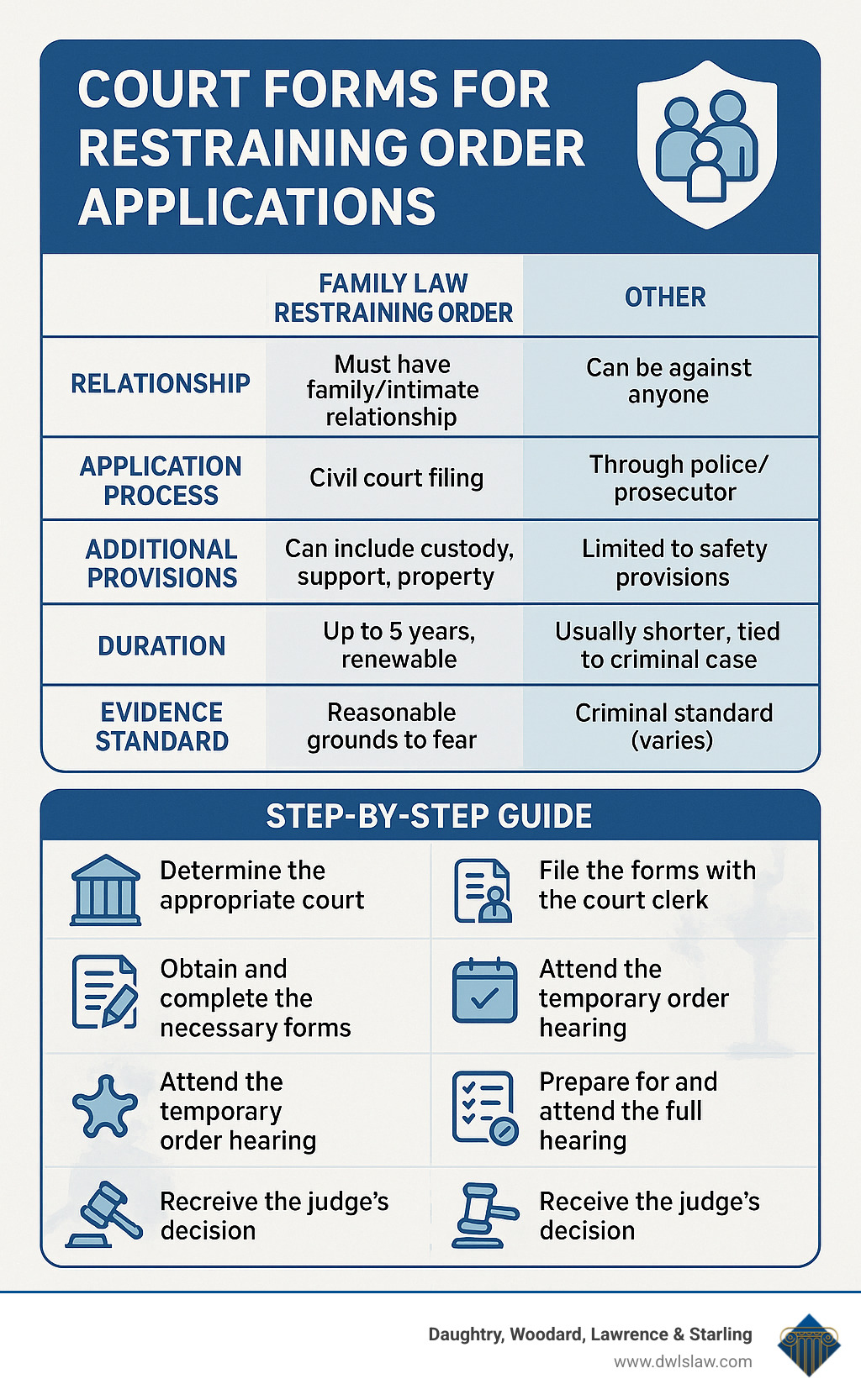
| Feature | Family Law Restraining Order | Peace Bond/Criminal Protective Order |
|---|---|---|
| Issuing authority | Family court | Criminal court |
| Relationship requirement | Must have family/intimate relationship | Can be against anyone |
| Application process | Civil court filing | Through police/prosecutor |
| Additional provisions | Can include custody, support, property | Limited to safety provisions |
| Duration | Up to 5 years, renewable | Usually shorter, tied to criminal case |
| Evidence standard | Reasonable grounds to fear | Criminal standard (varies) |
Peace bonds (available in some jurisdictions) and criminal no-contact orders work differently than family law restraining orders. They come through the criminal court system and don’t require a family or intimate relationship with the person you fear. The downside? They typically don’t address crucial family matters like child custody or support payments.
Stay-away orders share similarities with restraining orders but often have a narrower focus. They specifically require the restrained person to maintain a certain distance from you and protected locations, but might not include the broader protections that restraining order family law provisions can offer, such as temporary custody arrangements or property protection.
At Daughtry, Woodard, Lawrence & Starling, we understand that navigating these options during a frightening time can feel overwhelming. Our experienced family law team can help you determine which protective measure best fits your unique situation and guide you through every step of the process.
How to Get a Family-Law Restraining Order: Step-by-Step Guide
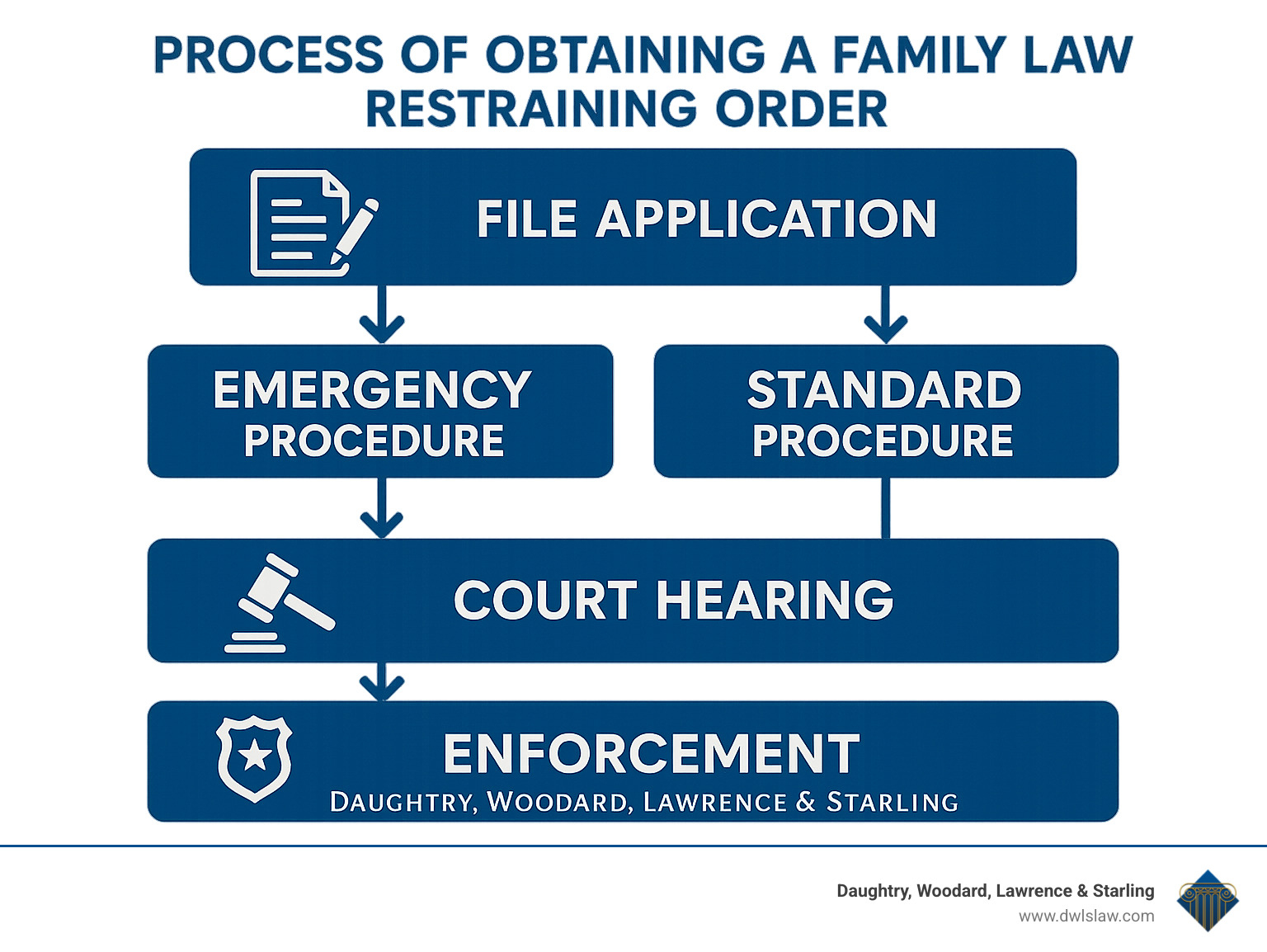
Navigating the process of obtaining a restraining order family law protection doesn’t have to be overwhelming. If you’re facing a situation where you need legal protection from a family member or intimate partner, here’s how to proceed:
Begin by visiting your local county courthouse. North Carolina residents in Smithfield should head to the Johnston County Courthouse, while Clinton residents will need the Sampson County Courthouse. The court clerk can direct you to the family court division where these matters are handled.
When you arrive, ask for the domestic violence protective order packet. Don’t worry about costs—there are typically no filing fees for these protective orders in North Carolina and most other jurisdictions. This ensures that financial concerns don’t prevent anyone from seeking safety.
Complete the forms carefully, providing detailed information about your situation. Once finished, submit them to the clerk who will arrange for a judge to review your petition. If you’re in immediate danger, be sure to request an “ex parte” emergency order. The judge can issue this temporary protection without the other person present, often on the same day you file.
After filing, the sheriff’s department will serve the other party with notice of both the temporary order and the upcoming hearing date. This service is crucial—the order cannot be enforced until the other person has been legally notified.
Within about 10 days, you’ll need to attend a full hearing where both parties can present their case. Bring all your evidence and be prepared to testify about your experiences. The judge will then decide whether to grant a longer-term protective order and what specific protections it will include.
“Restraining Order Family Law” Eligibility & Grounds
Not everyone qualifies for a family law restraining order. In North Carolina, you must have a specific relationship with the person you’re seeking protection from. You qualify if they are:
• Your current or former spouse
• Someone you currently live with or have lived with in the past
• A person with whom you share a child
• A current or former household member
• Someone you’re dating or have dated
Beyond the relationship requirement, you need valid grounds for the order. Fear for your safety is the foundation of most successful petitions. This fear must be reasonable and can stem from:
Physical harm or threats of violence are the most straightforward grounds. Stalking behavior like following you, appearing at your home or workplace unexpectedly, or constant unwanted contact can also qualify. Sexual assault or coercion is always valid grounds, as is any interference with your personal liberty or freedom of movement.
You don’t necessarily need to have already experienced physical violence. Credible threats that make you reasonably fear for your safety can be sufficient grounds for protection.
Gathering Evidence & Completing Forms
Building a strong case starts with solid evidence. Think of yourself as a detective documenting your own story:
Document everything. Keep a detailed journal noting dates, times, and descriptions of concerning incidents. Save threatening texts, emails, voicemails, and social media posts. These digital footprints can be powerful evidence in court.
Photograph any injuries or property damage. Medical records that document injuries provide objective evidence that’s hard to dispute. If police were ever called, obtain copies of those reports as well.
Witness statements can strengthen your case. Ask friends, family members, neighbors, or coworkers who witnessed concerning behavior to provide written statements or testify at your hearing.
When filling out the court forms, be specific and factual. Include exact dates and verbatim quotes whenever possible. Describe physical actions in detail rather than just labeling them (for example, “he grabbed my arm and pushed me against the wall” rather than just “he was violent”).
Our attorneys at Daughtry, Woodard, Lawrence & Starling can help you complete these forms correctly, ensuring you present your case in the strongest possible light. More info about our family law services
Emergency & Temporary Orders
When danger is imminent, the legal system offers faster pathways to protection:

Emergency Protective Orders (EPOs) provide immediate protection, typically lasting about 5 days. In truly urgent situations, these can often be obtained through law enforcement, even outside normal court hours. They give you breathing room to pursue a longer-term solution.
Temporary Restraining Orders (TROs), known in North Carolina as Ex Parte Domestic Violence Protective Orders, are granted after a brief initial hearing without the other party present. These typically protect you for 14-21 days until a full hearing can be scheduled.
When seeking emergency protection, be clear with the court clerk about the immediate nature of your danger. The clerk will prioritize your paperwork for same-day review by a judge. If granted, the order takes effect immediately once served on the other party.
These temporary protections are just that—temporary. They serve as a bridge to the full hearing where both sides will present their case. Come to that hearing well-prepared with all your evidence and, ideally, with legal representation to advocate for your safety and rights.
Living Under a Restraining Order: Protections, Custody & Compliance
When a restraining order family law decree takes effect, it creates a legal shield designed to keep you safe. These orders aren’t just pieces of paper—they provide real, enforceable protections that can help you regain peace of mind during difficult family situations.
The protection typically includes keeping the restrained person from contacting you through any means—no calls, texts, emails, social media messages, or even messages sent through friends or family. The order usually establishes specific distance requirements (often 500-750 feet) that the restrained person must maintain from you, your home, workplace, and your children’s schools.
If you’ve been sharing a home, the court may issue a move-out order requiring the restrained person to leave, giving you space to heal and plan your next steps. These orders also commonly include firearms restrictions—an important safety measure since access to firearms significantly increases the risk of lethal domestic violence.
“The day I received my protective order was the first time I felt I could breathe in months,” shares one of our former clients. “Knowing he couldn’t legally come near my workplace or my daughter’s school made all the difference.”
Beyond personal safety, these orders often protect shared property and even family pets, preventing the destruction or hiding of assets during this volatile time. For families with children, the order typically addresses immediate custody concerns and may include temporary child or spousal support provisions.
For those protected by the order, we recommend keeping a certified copy with you at all times. Share copies with your children’s schools, your workplace security team, and childcare providers. Document any violations immediately and report them to law enforcement without delay—consistency in enforcement helps ensure your continued safety.
If you’re the restrained person, understanding and following all conditions exactly is absolutely essential. Even if the protected person initiates contact, you must avoid responding, as this still constitutes a violation. Any necessary communication should happen only through attorneys or court-approved third parties, and attending all court hearings is non-negotiable.
Impact on Child Custody & Visitation
When children are involved, a restraining order family law case becomes even more complex. The court’s guiding principle is always the children’s best interests and safety, which often results in significant custody adjustments.
In most cases, temporary sole custody goes to the protected parent. The court then carefully considers what type of visitation arrangement (if any) would be appropriate:

Sometimes visitation is temporarily suspended entirely, especially if there’s evidence the children witnessed abuse or were directly harmed. In other situations, the court might order supervised visitation with a professional monitor or approved family member present. These visits typically happen at specific times and locations—often at supervised visitation centers designed to provide a safe, neutral environment for parent-child interaction.
North Carolina courts weigh several important factors when making these decisions, including the child’s safety and emotional well-being, any documented history of abuse, the mental and physical health of both parents, the quality of each parent-child relationship, and substance abuse concerns. For children 14 or older, the court may also consider their preferences.
“Safety during custody exchanges is often overlooked,” notes Kelly Daughtry, family law attorney at our firm. “We help clients request specific provisions—like exchanges at police stations or using a third-party intermediary—to minimize risk during these potentially volatile moments.”
If you’re worried about your children’s safety during custody exchanges or visitation, our team at Daughtry, Woodard, Lawrence & Starling can help you request these critical safety provisions.
Consequences of Violating the Order
Breaking the terms of a family law restraining order isn’t just disrespectful—it’s criminal. Violations can result in immediate arrest, significant fines, and even jail time. Each violation creates a permanent criminal record and can lead to improved penalties for repeat offenses. Perhaps most importantly for parents, violations severely damage credibility in future family court proceedings.
The reality is sobering: research shows restraining orders are violated in approximately 40% of cases. This highlights why documenting and reporting violations immediately is so crucial. In North Carolina, violations of domestic violence protective orders typically start as misdemeanors but can escalate to felony charges depending on the circumstances and history.
If you’re protected by an order and a violation occurs, your safety comes first. Call 911 immediately if you feel threatened. Once safe, document everything about the violation—date, time, what happened, and any witnesses present. Contact your attorney as soon as possible to determine if additional protective measures are needed.
For ongoing support beyond legal protection, resources like loveisrespect.org provide valuable guidance and emotional support for those navigating the challenges of restraining order enforcement.
At Daughtry, Woodard, Lawrence & Starling, we understand that living under the protection of a restraining order brings both relief and new challenges. We’re here to help you steer this difficult terrain with compassion, experience, and practical support every step of the way.
Modifying, Defending, or Ending a Restraining Order
Life circumstances change, and sometimes a restraining order family law situation needs to be revisited. Whether you’re seeking stronger protections or believe an order should be lifted, understanding your options is essential.
If you’re the protected person and need changes to your order, you have several options. When threats escalate or new safety concerns arise, you can file a motion to modify the existing order to include additional protections. As your order approaches expiration (typically 2-3 months before), you can request a renewal hearing to extend the protection period if you still have reasonable safety concerns.
For someone restrained by an order, it’s crucial to understand that even if you believe the order was obtained unfairly, you must comply with all provisions until a judge officially modifies or terminates it. Violations, even with good intentions, can result in criminal charges and damage your case.
In North Carolina, any modifications require filing the appropriate motion with the court that issued the original order. Both parties typically attend a hearing where the judge carefully considers the requested changes and the reasoning behind them.

Strategies if You Are Wrongly Accused
Being on the receiving end of false accusations in a restraining order family law case can feel overwhelming and unfair. If you believe you’ve been wrongly accused, there are steps you can take to protect your rights while respecting the legal process.
First and foremost, respect the temporary order completely, even if you believe it’s based on false information. Violating any provision will only strengthen the case against you and potentially result in criminal charges.
Gathering evidence that contradicts the allegations is critical to your defense. This might include text messages showing a different version of events, witness statements supporting your account, or documentation of your whereabouts during alleged incidents. Sometimes evidence of the accuser’s motivation to make false claims can be relevant, though courts are careful about admitting such evidence.
At Daughtry, Woodard, Lawrence & Starling, we understand how devastating false accusations can be. Our attorneys can help you present your side effectively while navigating the emotional challenges these cases present. We’ll help you prepare for your hearing by organizing evidence, practicing your testimony, and ensuring you understand courtroom protocols.
You have due process rights. The court must give you a fair opportunity to present your defense before making a final decision. Sometimes, proposing alternatives like mutual no-contact agreements can address legitimate concerns while avoiding the full impact of a one-sided restraining order.
Extending, Changing, or Terminating an Order
When circumstances evolve, restraining order family law provisions can be adjusted to reflect new realities.
For those seeking to extend protection, North Carolina allows you to request an extension before your current order expires. You’ll need to demonstrate an ongoing need for protection, which might include evidence of continued threats, violation attempts, or reasonable fear. Extensions typically last up to two years, and the court will hold a hearing where both parties can present their case.
Either party can request modifications based on significant changes in circumstances. The legal standard is a “material change in circumstances” – something substantial that affects how the order should function. Common modifications include adjustments to custody arrangements, communication protocols for co-parenting, or stay-away distances. Both parties have the opportunity to present evidence at these hearings.
If protection is no longer needed, terminating an order is possible. The protected person can request termination if they no longer feel threatened, or both parties can mutually agree to end the order. The restrained person can also petition for termination if they can demonstrate meaningful changes that eliminate the need for protection. However, the judge always makes the final decision based on safety considerations, sometimes denying termination requests even when both parties consent.
For any of these proceedings, our attorneys at Daughtry, Woodard, Lawrence & Starling can guide you through filing the proper forms with the court and preparing compelling evidence that supports your position. We understand that family dynamics are complex and ever-changing, and we’re here to help you steer these challenging legal waters with compassion and expertise.
Emotional & Practical Impacts, Safety Planning & Support Resources
Living with a restraining order family law situation affects everyone involved on a deeply personal level. Beyond the courtroom proceedings, there’s a whole landscape of emotions and practical challenges to steer.
If you’re the protected person, you might feel an immediate sense of relief knowing legal safeguards are in place. Yet many of my clients also describe unexpected feelings of anxiety about potential violations, or even guilt about family disruption. The stress of legal proceedings combined with financial worries—especially if your former partner was a primary provider—can be overwhelming.
Children caught in these situations often struggle in their own quiet ways. They may show confusion about family changes or have strong emotional reactions to violence they’ve witnessed. Adjusting to new custody arrangements isn’t easy, and many children feel torn between loving both parents despite the conflict.
For those under restraint, the emotional toll is significant too. Frustration and anger are common reactions, as are feelings of isolation from family. The practical challenges of sudden relocation and concerns about employment or community reputation add another layer of difficulty.
Whether you have a restraining order or not, creating a comprehensive safety plan is essential. Start with basic physical safety measures like changing locks, securing windows, installing simple security systems, and varying your daily routines. Many of our clients find that informing trusted neighbors, employers, and school personnel provides an additional layer of protection.
Communication safety is equally important in today’s connected world. Consider changing your phone number and email addresses, adjusting privacy settings on social media accounts, and using a P.O. box for mail to maintain privacy.
If you’re heading to court, plan ahead for your safety. Consider arriving early or late to avoid unexpected encounters, bring a supportive friend or family member, and don’t hesitate to request security escorts or separate waiting areas. Court personnel are generally very accommodating of these requests—your safety is their priority too.
North Carolina offers several valuable support resources that complement legal protection:
Legal Aid of North Carolina provides free legal assistance for those who qualify financially. Their dedicated domestic violence attorneys understand the nuances of restraining order family law cases.
The North Carolina Coalition Against Domestic Violence offers support, education, and connections to local resources. Their website and hotline can be lifelines when you’re feeling overwhelmed.
Local domestic violence shelters provide emergency housing, counseling, and practical support services. Many have children’s programs to help the youngest family members process their experiences.
Court Self-Help Centers can guide you through paperwork and procedural questions if you’re navigating parts of the process on your own.
At Daughtry, Woodard, Lawrence & Starling, we believe legal representation in restraining order family law cases should include connecting you with these supportive resources. Our approach combines legal expertise with genuine compassion—because we understand that behind every case file is a family going through one of life’s most challenging transitions.
For more information on safety planning and community resources, the Centre for Research & Education on Violence Against Women & Children offers excellent guidance that complements legal protection.
Conclusion
Finding your way through the maze of restraining order family law isn’t just about understanding legal terms—it’s about protecting yourself and your loved ones during some of life’s most challenging moments. Whether you’re seeking protection or responding to allegations, you deserve guidance that addresses both your legal needs and emotional wellbeing.
I’ve seen how overwhelming these situations can be. The paperwork alone can seem impossible when you’re already dealing with stress and fear. That’s why at Daughtry, Woodard, Lawrence & Starling, we walk beside you every step of the way, explaining options in plain language and helping you make informed decisions that prioritize safety and peace of mind.
Our team serves families throughout Johnston and Sampson Counties with a compassionate approach that recognizes the human side of legal challenges. We understand that behind every restraining order petition is a person seeking security and stability.
If you’re considering a restraining order—or have just been served with one—please don’t wait to reach out. Those first few days are crucial, and having proper legal guidance from the beginning can significantly impact your case outcome and personal wellbeing.
A restraining order is just one piece of a larger safety puzzle. We can connect you with counseling services, safety planning resources, and support groups that complement the legal protections we help you secure. Your children’s emotional needs during this transition are especially important, and we can help you access resources that support them too.
Your safety is non-negotiable. When you’re ready to take the next step, our Divorce Lawyer team is here to help with restraining orders and all related family law concerns. We bring decades of experience to your case, but more importantly, we bring understanding and respect for the difficult journey you’re on.
Daughtry, Woodard, Lawrence & Starling stands ready to provide the experienced, compassionate North Carolina representation you need for all your family law protection concerns. You don’t have to face this alone—we’re just a phone call away.
Frequently Asked Questions
Who can apply for a restraining order family law in North Carolina?
Current or former spouses, household members, dating partners, or parents sharing children can petition for a restraining order family law.
How long does a restraining order family law last?
Orders can be emergency (5 days), temporary (15–21 days), or permanent (up to 5 years) and may be renewed based on ongoing threats.
How fast can I get an emergency order?
When you’re facing a dangerous situation at home, time is of the essence. The good news is that emergency protective orders are designed to provide quick protection when you need it most.
In most urgent cases, you can obtain an Emergency Protective Order (EPO) the same day you request it. These orders typically last about 5 days, giving you a breathing space to pursue a longer-term solution. If you’re in immediate danger, law enforcement can often help you obtain an EPO even outside regular court hours.
For Ex Parte Temporary Restraining Orders, judges in North Carolina understand the urgency and typically make decisions either the same day you file or by the next business day. The court system prioritizes cases involving immediate safety concerns, especially when children are involved.
The process is straightforward but can feel overwhelming when you’re already stressed:
1. You’ll file paperwork with the court clerk (we can help with this)
2. You’ll have a brief hearing with a judge (the other person won’t be there)
3. If granted, the order takes effect as soon as it’s served on the restrained person
At Daughtry, Woodard, Lawrence & Starling, we’ve guided many clients through this process and can help you steer it quickly when your safety is at risk.
What evidence will the judge look at?
Judges make decisions about restraining order family law cases based on concrete evidence that demonstrates your safety concerns are reasonable. Think of it as telling your story with backup.
Your own testimony carries significant weight—judges listen carefully to your account of what happened. However, supporting evidence strengthens your case considerably. This might include photographs of injuries, medical records documenting treatment after incidents, or police reports from previous encounters.
Communication evidence can be particularly compelling. Those threatening text messages you’ve been saving? The voicemails with scary language? The constant unwanted emails? All of these help establish a pattern of behavior that justifies protection.
Witness statements from friends, family members, neighbors, or coworkers who observed concerning behavior can corroborate your account. Even if no one witnessed actual violence, someone who saw the aftermath or heard threats can provide valuable testimony.
You don’t necessarily need to have experienced physical violence to qualify for protection. Credible threats, stalking behaviors, or patterns of controlling conduct can be sufficient grounds. The judge is looking for “reasonable grounds” to believe you’re in danger—and specific, detailed evidence with dates, times, and exact words or actions will always be more convincing than vague allegations.
Can a restraining order affect my divorce or property case?
Yes, a restraining order family law decree significantly influences other family court matters—which is why coordinating all aspects of your legal situation is so important.
In divorce proceedings, a restraining order can establish grounds for divorce based on cruelty in fault-based states. It often changes how the divorce unfolds, with separate rather than joint mediation sessions becoming necessary. Many clients find that having a restraining order in place actually expedites temporary support and custody determinations, providing stability during a turbulent time.
For property matters, these orders typically include provisions that prevent your spouse from hiding, selling, or destroying shared assets—a crucial protection during separation. You may be granted exclusive use of the family home, regardless of whose name is on the deed or lease. The order can also address who controls vehicles, bank accounts, and other property temporarily until the divorce is finalized.
Perhaps most significantly, restraining orders profoundly impact child custody decisions. In many jurisdictions, including North Carolina, evidence of domestic violence creates a presumption against joint custody arrangements. The court may require supervised visitation or implement detailed, restrictive parenting plans to ensure children’s safety.
I’ve seen how these interconnected issues can become complicated quickly. At Daughtry, Woodard, Lawrence & Starling, we take a holistic approach to your family law matters, making sure your restraining order works in harmony with your divorce, custody, or property division proceedings rather than creating unintended consequences.